After a car accident on Long Island, you need medical care fast — and the right PT provider can make a real difference in both your recovery and your claim.

A car accident on Long Island turns your life upside down fast. Your car might be totaled, your neck is stiff, and suddenly you’re getting calls from insurance adjusters while trying to figure out whether you need a doctor, a lawyer, or both. The good news is that New York’s no-fault system is designed to cover your medical care — including physical therapy — regardless of who caused the crash. The part most people miss is that the physical therapist you choose, and how quickly you start treatment, can affect both your recovery and the strength of any legal claim you may have. Here’s what you actually need to know.
New York is a no-fault state, which means your own auto insurance covers your medical expenses after a crash — up to $50,000 per person — regardless of who was at fault. This coverage is called Personal Injury Protection, or PIP, and it pays for emergency care, follow-up appointments, diagnostic tests, prescription medications, physical therapy, lost wages, and even transportation to medical appointments.
What it does not cover is pain and suffering. To pursue compensation beyond your medical bills and lost income, your injuries typically need to meet New York’s “serious injury” threshold under Insurance Law §5102(d). That’s where a no-fault attorney in New York becomes essential — they help determine whether your case qualifies and what your next legal steps should be.

The no-fault system is designed to move fast, and it expects you to move fast too. Under New York’s Regulation 68, you must file your NF-2 application — the official no-fault claim form — within 30 days of the accident. Miss that window and you forfeit your no-fault benefits entirely. That’s not a soft guideline. It’s a hard cutoff.
From there, your medical providers have 45 days from the date of each treatment to submit bills to your insurer. Lost wage claims must be filed within 90 days of the accident. These deadlines often catch people off guard, especially when they’re focused on recovering from the crash itself or waiting to hear back from an attorney.
The statute of limitations for a personal injury lawsuit in New York is three years under CPLR §214 — so people sometimes assume they have plenty of time to sort everything out. But the no-fault application deadline is 30 days. Those two clocks are completely separate, and confusing them is one of the most common and costly mistakes accident victims make on Long Island.
One more thing worth knowing: if your insurer requests an Examination Under Oath — a formal proceeding where their attorney questions you under oath about the accident and your injuries — failing to appear can result in a denial of your no-fault benefits. It’s not optional, and it’s not something to handle without legal guidance.
Yes — physical therapy is explicitly covered under New York’s no-fault PIP benefits, up to the $50,000 limit. You do not need to pay out of pocket for PT if you’re treating under no-fault. What you do typically need is a prescription from a treating physician, such as the doctor you saw in the emergency room or at urgent care after the accident. You don’t need a specialist referral, but you do need that initial medical visit and documentation before a physical therapist can begin billing under no-fault.
Starting PT quickly matters for two reasons. Clinically, early intervention after a soft tissue injury — the kind most commonly caused by rear-end collisions on the Long Island Expressway or the Southern State Parkway — leads to better outcomes and a faster return to normal function. Legally, your treatment record begins the moment you start care. A consistent record of documented visits, objective measurements, and progress notes is what your attorney uses to establish that your injuries are real, ongoing, and serious.
Gaps in treatment are one of the most damaging things that can happen to both your recovery and your case. Insurance defense attorneys routinely point to missed appointments or breaks in care as evidence that the injuries weren’t as serious as claimed. Choosing a PT provider who understands this dynamic — and who documents your care with the kind of objective, measurable findings that hold up under scrutiny — is a decision that matters far more than most accident victims realize when they’re just trying to find someone close by.
Want live answers?
Connect with a Medcare Therapy Services expert for fast, friendly support.
No-fault covers your bills, but it doesn’t cover everything. If your injuries are serious — a fracture, significant loss of range of motion, a condition that prevents you from carrying out your normal activities for 90 out of the first 180 days post-accident — you may have grounds for a personal injury lawsuit on top of your no-fault claim. That’s when a personal injury attorney on Long Island becomes essential.
A PI attorney handles the legal side of your claim: gathering evidence, communicating with the insurance company, filing suit if necessary, and fighting for compensation that no-fault simply doesn’t provide. Most work on contingency, meaning you pay nothing unless they recover money for you. The earlier you involve an attorney, the better protected your rights are from the start.
Suffolk County has its own legal landscape. Cases filed in Riverhead or Central Islip move through different courts than those in Nassau County’s Mineola courthouse, and experienced car accident lawyers in Suffolk County understand those local dynamics — how juries in this county tend to respond, which judges are handling the docket, and how to build a case that accounts for the specific roads and conditions where the accident happened.
When you’re evaluating a car accident lawyer in Suffolk County, look for someone with direct experience in no-fault litigation, not just general personal injury work. The no-fault system has its own procedural rules, its own forms, and its own timeline — and an attorney who handles these cases regularly will know how to navigate an insurer’s attempt to cut off your benefits through an Independent Medical Exam or a peer review denial.
What many accident victims on Long Island don’t realize is that their attorney and their physical therapist are working toward the same goal: building a record that proves the seriousness of the injury. A good PT clinic understands this relationship. They use objective measurement tools — goniometric range-of-motion assessments, validated outcome scores, documented strength testing — that translate directly into the kind of medical evidence an attorney can use. When those two sides of the equation are aligned, the case is stronger.
After a serious crash, many people on Long Island physically cannot get themselves to a PT clinic. Their car is totaled. They’re in too much pain to drive. They live in eastern Suffolk County — somewhere along the Route 27 corridor past Patchogue — and the nearest clinic feels impossibly far when you can barely turn your neck.
Long Island’s car-dependent geography makes this worse than it would be in a city with real transit options. If you can’t drive, you’re stuck. And while you’re stuck, that 30-day no-fault clock is ticking and the gap in your treatment record is growing.
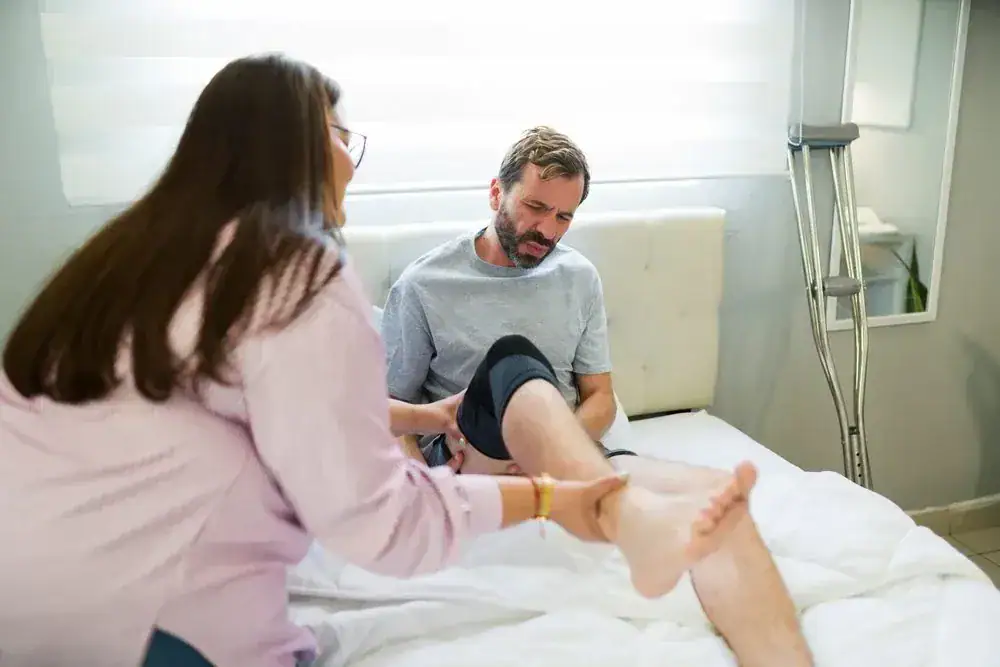
In-home physical therapy solves this directly. A licensed therapist comes to your home, works with you in your actual living environment — the hallway you navigate, the stairs you have to climb, the chair you’re spending most of your time in — and creates a documented treatment record that begins without delay. It’s not a lesser form of care. In many ways it’s more effective for accident recovery, because the therapy is calibrated to your real environment rather than a generic clinical setting.
We’ve been delivering in-home physical therapy across Suffolk County and Nassau County since 2010, and we have clinic locations in Smithtown and Speonk for patients who prefer or are able to come in. The Speonk location sits along the Route 27 corridor in eastern Suffolk — a stretch of road that sees serious accident volume, especially during summer months when Hamptons traffic surges. Whether you’re in Riverhead, Lindenhurst, Northport, or anywhere in between, we can get a therapist to you. The transportation barrier isn’t a reason to delay care — and it shouldn’t be.
The decisions you make in the first few weeks after a car accident on Long Island have a longer reach than most people expect. Starting treatment quickly, choosing a provider who documents your care properly, and understanding what no-fault covers — and what it doesn’t — can make a real difference in both how you heal and how your legal claim unfolds.
You don’t have to figure all of this out at once. But you do need to move on the 30-day deadline, and you need a physical therapist who understands the full picture — not just the clinical side.
If you’re looking for no-fault physical therapy on Long Island, Medcare Therapy Services offers both in-home care and clinic-based treatment across Suffolk and Nassau Counties. Reach out to us directly at 631-866-6507 to talk through your situation and get started.
Summary:


Article details:
Share: