A practical guide to what Medcare Therapy's community events actually offer, and why Long Island seniors are showing up before a fall ever happens.
Most people don’t start thinking about fall prevention until after something goes wrong. A near-miss on the stairs. A stumble in the driveway. A fall that sent someone they love to the emergency room. By that point, the conversation has already gotten harder than it needed to be.
Our community events, like the upcoming “Smart Choices, Informed Decisions” seminar, exist for a different reason: to give you real information, a real assessment, and a real conversation with local experts before any of that happens. No pressure, no commitment, no sales pitch. Just the kind of clarity that helps you make smart choices and informed decisions about your health and your independence.
Nassau County ranks fourth in New York State for fall prevalence among older adults. Suffolk County ranks fifth. Those aren’t national averages pulled from a general health report, that’s this community, these neighborhoods, these families.
When you consider that 88% of all injury hospitalizations for adults over 65 in Nassau County are caused by falls, the picture becomes hard to ignore. With more than 520,000 Long Island residents now over the age of 65, the demand for real, accessible fall prevention care has never been higher.
Long Island’s housing stock doesn’t help. The split-levels, raised ranches, and older colonials that define communities from Smithtown to Freeport, from Commack to Holtsville, weren’t built with aging in mind. Steep driveways, narrow hallways, bathrooms without grab bars, basements with uneven stairs, these are the environments where falls happen. Our therapists work throughout Suffolk and Nassau County, and we see these hazards every day.

Here’s what our events are not: a lecture hall full of generic advice, a brochure you could have downloaded at home, or a soft sales environment where someone follows up with you three times a week. We want to be straightforward about that because we know that’s what people are worried about.
Our events are a low-stakes opportunity to meet our team, ask the questions you’ve been sitting on, and receive a real fall risk screening from a licensed therapist. Our upcoming “Smart Choices, Informed Decisions” event takes place on Wednesday, November 18, 2026, from 10:00 AM to 11:00 AM at the Hauppauge Library in Classroom D (1373 Veterans Memorial Hwy ste 1). That screening looks at the specific factors that contribute to falls: strength, balance, gait, and how your body responds when it’s challenged.
This presentation will be facilitated by three experts in their fields: Danielle Moloney-Hassett (funeral preplanning); Kiersten Palma, RN (Medicare); and Stephen M. Joseph, PT (physical therapy). What you walk away with is clarity. You’ll know whether your balance concerns warrant a clinical program, like the evidence-based OTAGO Exercise Program that Stephen M. Joseph, PT will demonstrate, or whether there are specific changes you can make at home that will meaningfully reduce your risk.
This is the question we hear more than almost any other, and the short answer is yes, when fall prevention physical therapy is medically indicated, Medicare covers it. Our therapists are Medicare-certified, and we accept most commercial insurance as well. Cost should not be the reason someone puts off getting assessed, which is exactly why Kiersten Palma, RN will be covering Medicare options and Cost Assistance programs at the November 18th event.
This matters enormously on Long Island, where nearly half of seniors have no retirement savings and a significant portion of the older adult population is on a fixed income. The communities we serve, from Holtsville and Commack in Suffolk to Garden City and Roslyn in Nassau, include a wide range of financial situations, and we don’t think access to quality fall prevention care should be determined by zip code or retirement account balance.
What Medicare typically covers in a fall prevention physical therapy context includes the initial evaluation, the development of a personalized treatment plan, and the one-on-one therapy sessions that follow. The specifics depend on your individual situation and coverage, which is exactly why our community events are a useful starting point, you can ask those questions directly and get straight answers.
The free community programs available through other organizations on Long Island (group workshops, general balance classes) have real value for awareness and social connection. But they can’t bill Medicare, they can’t provide an individualized clinical assessment, and they can’t follow you home to address the specific hazards in your actual environment. That gap is where clinical fall prevention care, and specifically in-home physical therapy, makes a meaningful difference.
Want live answers?
Connect with a Medcare Therapy Services expert for fast, friendly support.
A lot of fall prevention content online describes what you should do in broad strokes. Strengthen your legs. Improve your balance. Remove trip hazards. That advice isn’t wrong, but it’s not a plan.
A plan is specific, it’s personalized, and it’s built around your body, your home, and your goals. Our fall prevention program starts with a comprehensive assessment, not a questionnaire, but an actual evaluation conducted by a Doctor of Physical Therapy with specialized training in geriatric care. From there, we build a treatment plan that addresses the specific factors driving your risk, and we track your progress over time so we can adjust as you improve.
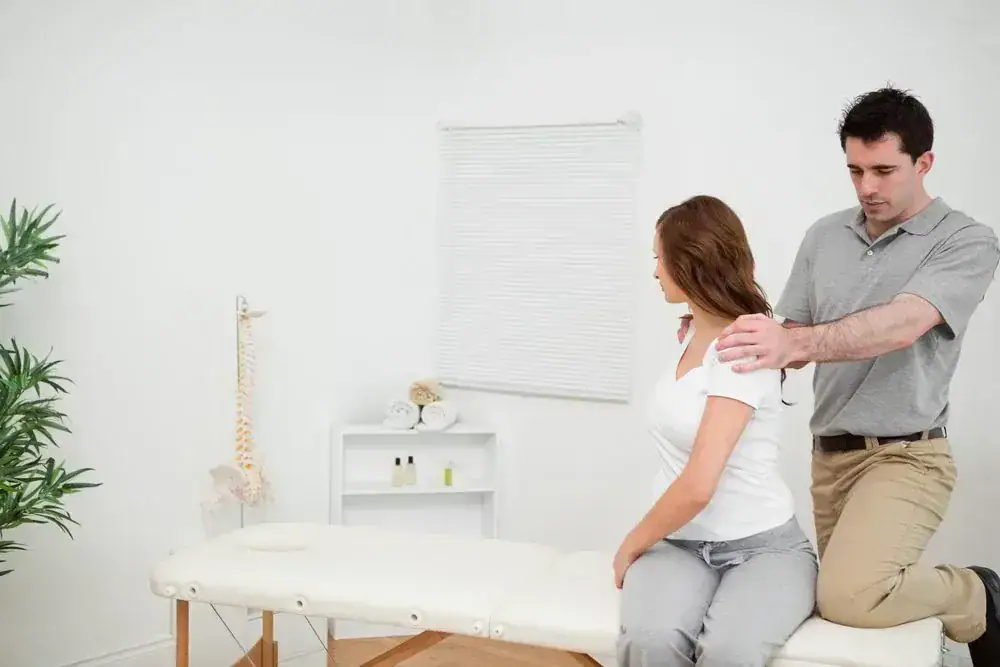
The assessment we conduct looks at the full picture, not just whether you’ve fallen before. We evaluate strength, particularly in the hips and ankles, which are the muscle groups most directly involved in balance and recovery from a stumble. We assess gait, which is how you actually walk, because the way someone moves tells a trained therapist a great deal about where vulnerability exists.
We look at proprioception, which is your body’s ability to sense where it is in space, a factor that declines with age and is one of the less obvious contributors to fall risk. We also conduct a home safety assessment for patients receiving in-home care. This is where the in-home model genuinely outperforms a clinic setting for fall prevention specifically.
When a therapist comes to your home in Smithtown, Setauket, Williston Park, or anywhere across Suffolk and Nassau County, they can see the steep front steps, the bathroom without a grab bar, the area rug at the end of the hallway, and the lighting situation at the top of the stairs. Those are the real hazards. A clinic can’t see them. We can.
The program is one-on-one throughout. You work with the same therapist at every session, not a rotating roster of whoever is available that day. That consistency matters clinically, because your therapist learns how you move, what’s improving, and where you still need work. It also matters personally, because trust builds over time.
Evidence-based fall prevention programs like the kind we deliver can reduce fall risk by up to 35%. That’s not a marketing figure, it’s the outcome data behind structured, individualized physical therapy for balance and fall prevention. For someone who has already fallen once, that number is especially relevant, because falling once doubles your chance of falling again.
This is a misconception worth addressing directly, because it keeps some people from choosing the option that would serve them better. In-home physical therapy is not a compromise. It is not a watered-down version of clinic care offered to people who can’t make it in.
For fall prevention specifically, treating someone in their actual living environment is often the more clinically sound approach. Think about what a clinic can observe: how you perform on a balance board, how you walk down a hallway with consistent lighting and a flat floor. Now think about what a therapist sees when they come to your home in Freeport, Cold Spring Harbor, or anywhere else across Long Island: the uneven patio, the stairs you navigate every morning, the bathroom you use at 2 a.m. when the lighting is off. The real fall risk lives in the real environment.
For Long Island seniors specifically, the in-home model also removes a barrier that is genuinely prohibitive for many people. Long Island is car-dependent in a way that urban areas are not. If you can no longer drive safely, getting to a clinic twice a week requires someone else’s schedule, someone else’s availability, and a level of dependency that many seniors are reluctant to impose on their adult children. When we come to you, that barrier disappears entirely.
We are not a franchise, and we are not a rotating door of contractors. The therapist who comes to your home is part of our team, trained in geriatric care, and accountable to the same standards we hold at our Smithtown clinic. Our Speonk location also serves residents across the East End (Eastport, East Moriches, Manorville, and the surrounding communities) so the in-home model extends across a wide footprint of Long Island without any drop in care quality.
The best fall prevention program is the one you can access consistently. For a significant portion of Nassau and Suffolk County seniors, that means care that comes to them.
Falls are not inevitable. That’s the most important thing we can say, and we mean it. The unsteadiness, the near-misses, the quiet worry about what happens if you go down, those are signals worth paying attention to, not things to wait out.
The seniors who come to our community events and start a fall prevention program aren’t in crisis. They’re the ones who decided to be proactive while they still had the advantage of time. Nassau and Suffolk County have some of the highest fall rates in New York State. Long Island’s homes, its winters, and its car-dependent geography all contribute to a real and elevated risk for older adults here.
But that risk is measurable, and it’s treatable. You don’t have to accept it. If you’re ready to get clear answers, understand your actual risk, and find out what a personalized fall prevention program would look like for you, joining us on November 18 at the Hauppauge Library is the smart choice. You can learn from experts like Danielle Moloney-Hassett (funeral preplanning) and Kiersten Palma, RN (Medicare) alongside our physical therapy guidance. Reach out to us directly, no referral needed, no obligation, and no pressure. Just an honest conversation with people who have been doing this work in this community for a long time.
Summary:


Article details:
Share: