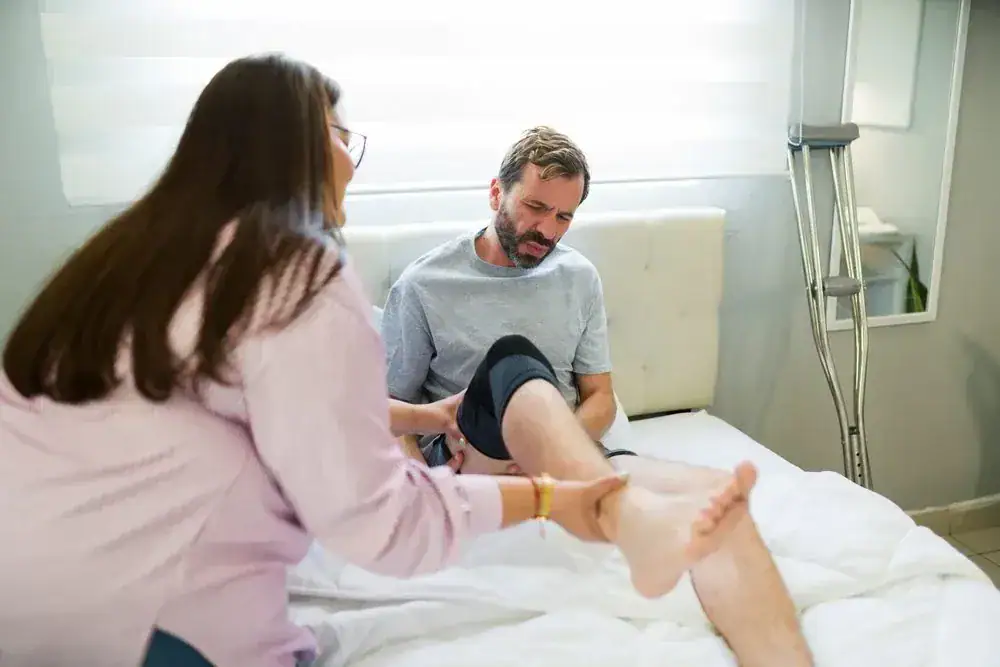
One in four adults over 65 falls every year. Here's what fall prevention therapy actually involves — and why where you do it matters more than most people realize.

If you’ve been grabbing the counter more often, hesitating at the top of the stairs, or lying awake after a close call, you already know something has shifted. That feeling — the second-guessing, the slowing down, the quiet fear — is one of the most common things we hear from patients across Nassau and Suffolk counties. And it’s one of the most treatable.
Fall prevention isn’t about doing a few stretches and hoping for the best. It’s a structured, evidence-based process — and when it’s done right, in the right environment, it works. Here’s what you should know.
Most people picture fall prevention as a generic exercise class or a handout of home stretches. The reality is more specific — and more effective — than that. A proper fall prevention program starts with a formal assessment: your gait, your balance, your strength, your reaction time, and the physical layout of your home. From there, we build a plan around what’s actually driving your risk, not a one-size-fits-all protocol.
Sessions typically include balance training, gait work, neuromuscular re-education, and functional strength exercises — all progressed at a pace that matches where you are right now. Most patients start noticing real stability improvements within three to four weeks. Meaningful, lasting fall risk reduction generally takes eight to twelve weeks of consistent work.

Here’s something worth thinking about: most falls don’t happen on a clinic floor. They happen on the stairs you climb every morning, in the hallway between your bedroom and bathroom, on the driveway after rain. Practicing balance in a clinical setting that simulates your home is useful. Practicing it in your actual home is better.
When we work with you inside your own space, we can assess the real hazards — the throw rug at the base of the stairs, the bathroom without grab bars, the dim hallway light you’ve been meaning to replace. We train you on the specific surfaces and transitions that your daily life actually requires. That kind of specificity is hard to replicate in a clinic.
For seniors across Nassau and Suffolk counties, this matters even more because of the housing stock. Long Island’s post-war homes — the Cape Cods, split-levels, and ranch houses built between the 1940s and 1970s — come with narrow staircases, older bathrooms, and layouts that weren’t designed with aging in mind. We’ve been inside hundreds of these homes. We know what to look for, and we know what changes make the biggest difference.
There’s also a practical reality: getting to a clinic twice a week is harder than it sounds. Long Island traffic on the LIE or Sunrise Highway isn’t a minor inconvenience for someone managing chronic pain or recovering from surgery — it’s a real barrier that causes people to skip sessions or stop treatment altogether. When we come to you, that barrier disappears. Consistency becomes easier, and consistency is what produces results.
The timing of when you start therapy has a dramatic effect on how much it helps. Research shows that beginning physical therapy within three months of noticing balance issues can reduce fall risk by up to 86 percent. That’s not a small improvement — that’s a near-elimination of risk for patients who act before a serious fall occurs.
Most people wait. They chalk up a stumble to being tired, or they tell themselves they’ll deal with it after the holidays, or they assume nothing can really be done. By the time they start therapy, they’ve often already had a significant fall — a hip fracture, a head injury, a hospitalization — and now they’re recovering from trauma instead of preventing it.
The window matters. If you’ve noticed changes in your steadiness, your walking pattern, or your confidence on stairs, that’s the moment to act — not after something worse happens.
Nassau and Suffolk counties rank fourth and fifth in New York State for fall-related hospitalizations. That’s not a national average — that’s your county, your neighbors, your community. In Nassau County specifically, 88 percent of injury hospitalizations among seniors are fall-related. These numbers reflect a real and local problem, and they’re the reason we’ve built our practice around making fall prevention as accessible as possible for Long Island residents.
Want live answers?
Connect with a Medcare Therapy Services expert for fast, friendly support.
This is one of the most common questions we hear, and the short answer is yes — Medicare covers medically necessary physical therapy for fall prevention, balance disorders, and related conditions. The key phrase is “medically necessary,” which a licensed physical therapist determines based on your assessment.
Before your first visit, we verify your coverage directly. You’ll know what’s covered and what, if anything, you’ll owe before you commit to anything. For patients on fixed incomes, that pre-verification isn’t a convenience — it’s the thing that makes starting care possible.

In New York State, you can begin physical therapy without a physician referral. This is called direct access, and it means you don’t have to wait for a doctor’s appointment, a referral letter, or prior authorization before getting started. If you’ve been putting off therapy because you weren’t sure how to navigate the process, that barrier isn’t as high as it might seem.
That said, we do coordinate with your physician when it’s clinically appropriate — particularly if your fall risk is connected to a medication regimen, a recent diagnosis, or a post-surgical recovery. Many of the medications prescribed for blood pressure, sleep, anxiety, and pain can cause dizziness or drowsiness that significantly increases fall risk. We flag those concerns and make sure your primary care doctor is part of the conversation.
For seniors managing multiple prescriptions — which is common across Long Island’s older adult population — this kind of coordination can be just as important as the exercise program itself. Polypharmacy is one of the most underappreciated fall risk factors, and it’s one that we address directly rather than work around.
If you’re in a community like East Meadow, North Babylon, Amityville, or Patchogue — areas with some of the highest Medicare enrollment rates on Long Island — you’re likely already navigating a complex healthcare picture. We’re set up to work within that picture, not alongside it.
Your first session is mostly about assessment. We evaluate your balance, your gait, your strength, and your home environment — looking at the specific surfaces, transitions, and daily movements that are part of your actual routine. From that, we build a treatment plan that’s specific to you, not a standard protocol pulled from a shelf.
Every session after that is one-on-one with the same licensed physical therapist. Not a rotating cast of assistants, not a group class, not someone who needs you to re-explain your history each time. The same person, building on what they learned last session, adjusting your program as you improve. For most patients, that continuity makes a significant difference — both in outcomes and in how comfortable they feel pushing themselves.
Most patients need somewhere between seven and eleven visits depending on their condition and goals. Some need more, some need fewer. The honest answer is that it depends on where you’re starting and how consistently you’re able to work. What we can tell you is that the program is graduated — it starts where you are, not where someone else thinks you should be — and that we’re not going to push you past what’s safe or appropriate.
For seniors in eastern Suffolk County communities like Eastport, Peconic, or Middle Island, where the distance to a clinic can be genuinely prohibitive, in-home therapy isn’t a luxury — it’s often the only realistic path to consistent care. We serve a wide geographic footprint across both counties precisely because we know that access to therapy shouldn’t depend on how close you live to a clinic.
Falls are predictable, and for most people, they’re preventable. The research is clear, the programs are proven, and the window for early intervention is real. What tends to get in the way isn’t motivation — it’s access, logistics, and not knowing where to start.
If you or someone in your family has been feeling less stable than usual, the best time to address it is now, before a fall changes the conversation entirely. The difference between starting therapy today and waiting another few months can be measured in outcomes that matter — staying in your home, walking without fear, getting through a day without holding onto walls.
We’ve been working with Long Island families since 2000. If you’re ready to take the next step, reach out to us directly — we’ll verify your coverage, answer your questions, and get you started without making it complicated.
Summary:


Article details:
Share: