The seminar gave you the information. Now here's how to actually use it, and why that next step matters more than most people realize.

You came to the seminar. You listened, took notes, maybe picked up a handout or two. And somewhere on the drive home, you thought, okay, I really need to do something about this.
That moment matters. Most people never get there. But here’s what we’ve seen over 25 years of working with seniors across Suffolk County and Nassau County: the seminar is the start, not the solution. The advice is sound. The challenge is making it real: in your home, with your body, around your actual daily life. That’s what this post is about.
There’s a reason people leave educational events feeling motivated and then, two weeks later, haven’t changed a thing. It’s not laziness. It’s that population-level advice, the kind that works for a room full of people, can’t account for what’s going on with you specifically.
A seminar can explain that muscle weakness is a major fall risk factor. It can’t tell you which muscles are weak in your legs, how that weakness is affecting your gait, or what exercises are appropriate given your medical history. That gap between knowing and doing is exactly where most fall prevention efforts break down, and where professional guidance becomes the difference between feeling informed and being safer.

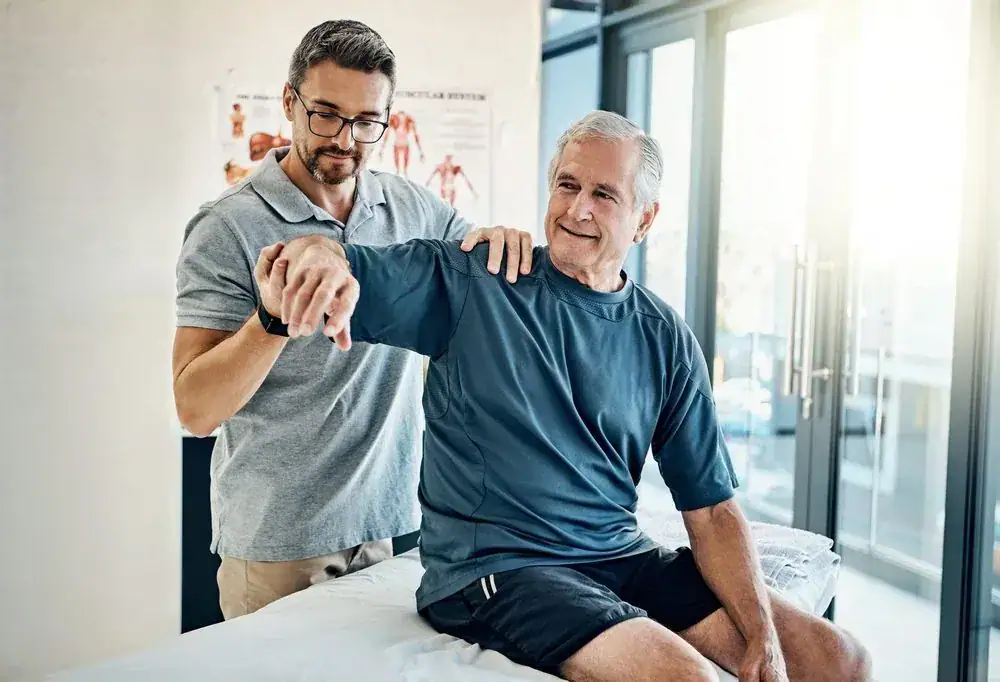
When one of our physical therapists conducts a fall risk assessment, they’re not running through a generic checklist. They’re building a picture of your specific situation, the factors that are actually putting you at risk, not the ones that put the average 70-year-old at risk.
That means looking at your strength, your balance, and your gait, how you move through your home, not how you move in a clinic hallway. It means asking about your medications, because certain blood pressure drugs, sleep aids, and even common antihistamines can affect your balance in ways most people don’t connect to fall risk. It means asking about your vision, because depth perception and peripheral vision both decline with age and both contribute to falls in ways that exercise alone won’t fix.
It also means looking at your home. This is where the in-home model we use makes a real difference. When a therapist comes to you, rather than you coming to a clinic, they see the rug at the bottom of your stairs, the bathroom without a grab bar, the hallway where the light switch is on the wrong side of the room. Those aren’t hypotheticals. They’re the specific conditions in your specific home, and they’re the ones most likely to cause a problem.
Most homes across Suffolk County and Nassau County were built between the 1950s and 1970s: split-levels, steep staircases, narrow bathrooms, no accessibility features built in. A comprehensive assessment catches those problems before they become emergencies. That’s the point. Not to alarm you, to give you a clear, honest picture of what you’re working with.
This is the one we hear most often: “I’ve been doing the exercises they gave us.” And that’s genuinely good. Any movement is better than none. But self-directed exercise from a printed handout carries real limitations, and a few real risks, that are worth understanding.
The first issue is form. Balance and strength exercises done incorrectly don’t just fail to help, they can cause injury. Without someone watching and correcting, it’s easy to develop habits that feel fine but aren’t doing what you think they’re doing. The second issue is progression. A good fall prevention program doesn’t stay the same week after week. It starts where you are and builds at a pace that’s right for your body. A handout can’t adjust based on how you responded to last week’s session. A physical therapist can.
The third issue, and arguably the most important, is that exercise alone addresses only part of the picture. Research on the OTAGO Exercise Program (the evidence-based fall prevention protocol Stephen M. Joseph, PT demonstrated at the seminar) shows that a structured, individualized home exercise program delivered by a physical therapist reduced falls rate by 36% over 12 months. That result comes from a supervised, personalized, progressive program. Not from a handout.
Balance exercises alone reduce fall risk by roughly 23 to 24 percent. Combine them with strength training and that figure rises to 30 to 35 percent. Those numbers are real, but they reflect programs done correctly, with professional guidance, not exercises approximated from memory at home.
Want live answers?
Connect with a Medcare Therapy Services expert for fast, friendly support.
After our fall prevention events like the “Smart Choices, Informed Decisions” seminar at the Hauppauge Library, we hear a lot of the same questions. Some people ask them in the room. A lot more think of them on the way home. These are the ones that come up most often, and the honest answers to each.
We want you to have the full picture before you decide what to do next, because informed decisions are the whole point.
Yes, and this surprises a lot of people. As Kiersten Palma, RN discussed during her presentation on Medicare options, Medicare Part B covers outpatient physical therapy when it’s medically necessary, and fall prevention qualifies. If you have documented fall risk factors (balance problems, a history of falls or near-falls, muscle weakness affecting your gait) that’s a medically necessary reason to pursue physical therapy, and Medicare recognizes it as such.
The confusion usually comes from people assuming that because it’s preventive, it won’t be covered. That’s not how Medicare looks at it. If the underlying condition (balance deficit, strength deficit, gait impairment) is documented and clinically relevant, the therapy is covered.
We verify your benefits before your first visit. You’ll know what’s covered and what, if anything, isn’t before any treatment begins. There are no surprise bills. If you’re on Medicare and you’ve been putting this off because you assumed it would cost too much, that assumption is worth checking.
Nassau County has some of the highest fall-related injury hospitalization rates in New York State: 88 percent of all injury hospitalizations for adults over 65 in Nassau County are caused by falls. That’s not a national average. That’s the county you live in. The average emergency room visit after a fall costs nearly $9,000. Physical therapy, covered by the insurance you’re already paying for, is not the expensive option.
This is the most common reason people wait. They haven’t fallen. They’ve had a close call, maybe (a stumble on the back steps, a moment of unsteadiness getting out of the car) but nothing serious. So they figure they’re not bad enough yet.
Here’s what the research actually says: falling once doubles your risk of falling again. And most people who have a near-fall don’t mention it to their doctor. It feels embarrassing. It doesn’t seem like a “real” medical event. So it goes unreported, the underlying risk factors go unaddressed, and the next close call has a higher chance of being an actual fall.
A near-fall is a clinical signal. It means something in your balance, strength, gait, or environment is off, and it’s worth finding out what. That’s exactly the kind of proactive thinking that the Wednesday, November 18 seminar in Classroom D at the library was designed to encourage. There’s also a psychological dimension here that doesn’t get talked about enough. Fear of falling is itself a fall risk factor. Physical therapy addresses both sides of that: the physical conditioning and the confidence to move without second-guessing every step.
If you’re somewhere between “fine” and “I’ve already fallen,” that’s the best time to act. The goal of fall prevention isn’t to recover from a fall, it’s to make sure the fall doesn’t happen. The seniors we work with across Hauppauge, Kings Park, Commack, Merrick, and Garden City who come in before something serious happens are the ones who stay independent the longest.
The seminar gave you a foundation. You know what fall risk looks like, why it matters, and what kinds of changes make a difference. You understand advanced planning options from Danielle Moloney-Hassett, Medicare facts from Kiersten Palma, RN, and the importance of mobility from Stephen M. Joseph, PT. That’s more than most people have. Now the question is what you do with it.
Generic advice has a ceiling. At some point, the only way to know your risk, and actually reduce it, is to have someone assess you specifically. Your strength, your balance, your home, your medications, your history. That’s what we do.
We’ve been part of this community for a long time. Physical Therapy Associates of Smithtown has been here since 2000. Medcare Therapy Services has been bringing licensed physical therapists directly into Long Island homes since 2010. We’re not a franchise, and we’re not a rotating roster of contractors. When you work with us, you’ll see the same therapist, who knows your name, your goals, and your home.
If you’re ready to take the next step, or just want to talk through what that might look like, reach out to Medcare Therapy Services. The conversation doesn’t cost anything, and knowing where you stand is always worth it.
Summary:
Article details:
Share: