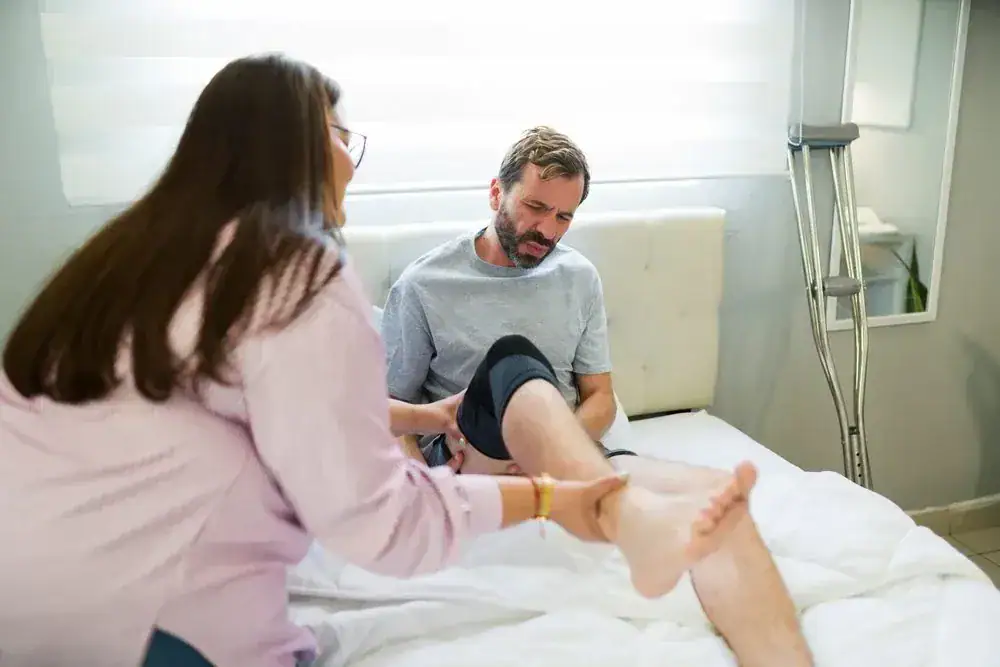
Falls are preventable — and the right therapy makes a real difference. Here's what fall prevention actually looks like for Long Island seniors, and how to get started.

If you’ve noticed yourself hesitating at the top of the stairs, gripping the wall on the way to the bathroom, or quietly dreading icy mornings in the driveway — you’re not imagining things, and you’re not alone. Balance changes as we age. Strength shifts. And the fear of falling, once it settles in, has a way of making everything feel smaller.
The good news is that this is one of the most treatable things in all of physical therapy. Fall prevention isn’t about slowing down — it’s about staying in your home, on your own terms, for as long as possible. Here’s what that actually looks like when it’s done right.
Fall prevention therapy isn’t a generic exercise class or a printed sheet of stretches to do at home. It’s a clinical process that starts with understanding why your balance or strength has changed — and then building a specific plan to address it.
Our licensed physical therapists assess how you move, how you stand, how you recover when you lose your footing, and what’s happening in your environment that might be putting you at risk. From there, the work focuses on building the strength and stability your body needs to stay upright when it matters — getting out of a chair, walking to the mailbox, navigating a wet floor.
The research backs this up. A well-structured fall prevention program combining balance training, strength exercises, and a home safety assessment can reduce fall risk by up to 35%. That’s a meaningful reduction when you consider that fall-related deaths among older adults have increased significantly over the past decade.
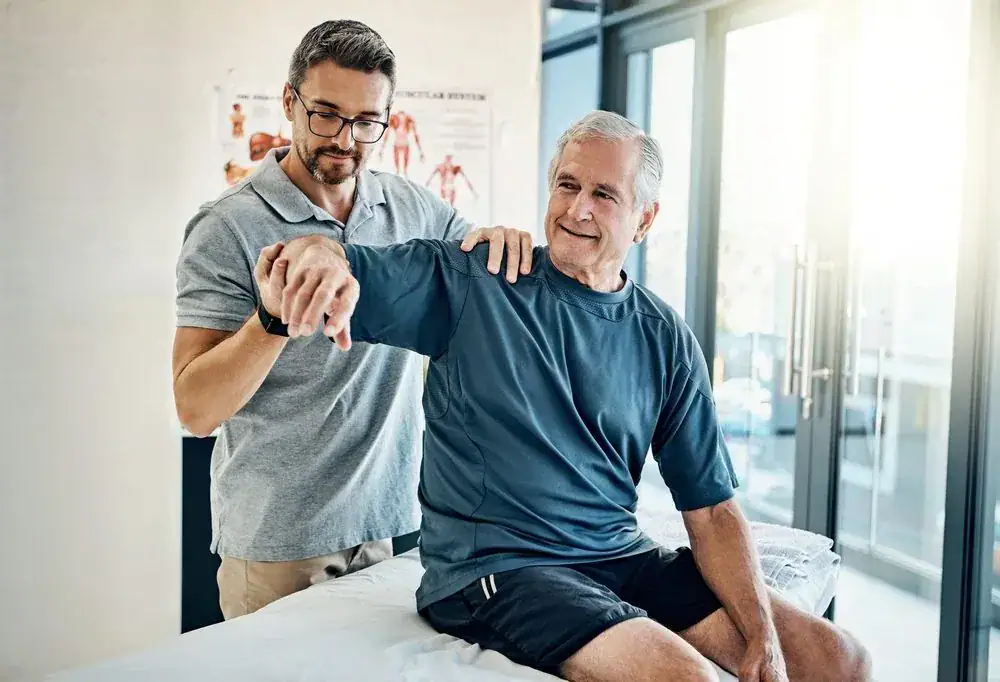
A fall risk assessment is the starting point, and it covers more ground than most people expect. It’s not just “can you stand on one foot.” A thorough evaluation looks at your gait — how you walk, how you turn, how you start and stop. It looks at leg strength, reaction time, and how well your body responds when your center of gravity shifts. It also factors in your medical history, any medications you’re taking that might cause dizziness or affect your blood pressure, and your living environment.
That last part matters more than people realize. Most falls happen at home — not on a hiking trail or in a parking lot. They happen on the way to the kitchen at night, stepping out of the shower, or reaching for something on a high shelf. A proper assessment accounts for your actual life, not a clinical simulation of it.
We offer in-home services across Suffolk County and Nassau County, and for good reason. When a therapist comes to your home, they can see the throw rug in the hallway, the poorly lit staircase, the bathroom without a grab bar. We help you address the specific hazards in your specific space — not a generic checklist of things that may or may not apply to you.
For many seniors in Smithtown, Hauppauge, Commack, and the surrounding communities, getting to a clinic for every appointment isn’t realistic. Traffic on the LIE alone can turn a simple errand into an ordeal. In-home therapy removes that barrier entirely and, in many cases, produces better outcomes because the work is happening in the actual environment where falls occur.
The assessment also looks at fear. Fear of falling is a recognized clinical condition — not an overreaction. When someone starts limiting their activity because they’re afraid of falling, their muscles weaken, their balance deteriorates, and their risk actually increases. Addressing the psychological side of fall risk is part of the work, not an afterthought.
Balance and strength aren’t the same thing, but they’re deeply connected. You can have strong legs and still have poor balance. You can have decent coordination and still lack the leg strength to recover when you stumble. Our fall prevention therapy works on both — and the combination is what drives results.
Balance training focuses on your body’s ability to detect and respond to shifts in position. This involves your inner ear, your vision, and the sensory feedback from your feet and joints — a system called proprioception. As we age, all three of these inputs can become less reliable, and the nervous system’s ability to integrate them slows down. Targeted exercises retrain that system. Neuromuscular re-education, which is a core part of what we do, has been shown in published research to reduce falls by 23 to 24 percent on its own.
Strength training for fall prevention isn’t about building muscle mass. It’s about functional strength — the kind that helps you get up from a low chair without using your arms, hold your footing on an uneven surface, or catch yourself before a stumble becomes a fall. Hip strength, ankle stability, and core control are the focus areas that matter most.
When you combine balance retraining, functional strength work, and a home safety assessment into a single coordinated program, the impact grows significantly. These aren’t separate interventions stacked on top of each other. They’re designed to work together, because the body doesn’t operate in isolated parts.
Long Island winters add another layer of urgency to all of this. Suffolk County averages 25 to 30 inches of snow annually, and ice events are common from December through March. Seniors who haven’t maintained their strength and balance through the fall months are walking into that season at a real disadvantage. Starting a program before winter arrives — not after a fall on a frozen driveway — is always the better call.
Want live answers?
Connect with a Medcare Therapy Services expert for fast, friendly support.
There are free fall prevention programs available on Long Island — group workshops, Tai Chi classes at senior centers, online sessions through community health organizations. They have real value for general awareness and fitness, and we’d never discourage anyone from participating in them.
But they’re not the same as one-on-one clinical physical therapy, and it’s worth being honest about that distinction. A group class can’t assess your specific balance deficits. It can’t evaluate your home. It can’t adjust your program week to week based on how your body is responding. It can’t catch the things that a licensed therapist catches when they’re focused entirely on you.
That’s the difference we deliver — and it’s the difference that changes outcomes.
This is one of the most common questions we hear, and the answer matters because financial uncertainty stops a lot of people from making the first call.
Medicare covers physical therapy — including fall prevention therapy — when it’s medically necessary and provided by a licensed therapist. That includes in-home physical therapy for patients who qualify. Most commercial insurance plans cover it as well. We are Medicare-certified, and our team will work with you to clarify your coverage before you commit to anything.
The financial case for acting sooner rather than later is also worth understanding. Research from the American Physical Therapy Association estimates that choosing physical therapy for fall prevention saves approximately $2,144 per patient when you account for the downstream costs of a fall — emergency care, hospitalization, rehabilitation, and lost independence. A fall is not just a physical event. It often triggers a cascade of medical expenses, care needs, and life disruptions that are far more costly than prevention.
For Suffolk County and Nassau County residents on Medicare, the coverage question shouldn’t be what’s stopping you from getting a fall risk evaluation. If you’re unsure about your specific plan, call us and we’ll help you figure it out. No one should be sitting with a preventable risk because of a coverage question that has a clear answer.
In New York State, you also don’t need a doctor’s referral to see a physical therapist. You can self-refer for a fall risk assessment, which means there’s no waiting for a physician appointment to get the process started.
There’s something that matters in healthcare that doesn’t show up on a credential — and that’s knowing the community you serve. Not as a demographic or a patient population, but as neighbors.
Physical Therapy Associates of Smithtown, our flagship clinic at 100 Maple Avenue just south of Main Street, has been part of this community since 2000. That’s 25 years of treating people from Smithtown, Kings Park, St. James, Commack, and the surrounding neighborhoods. People come in having heard about us from a neighbor, a friend from church, a family member who went through a knee replacement years ago. That kind of continuity isn’t something a recently opened clinic or a regional chain can offer.
Our therapists work one-on-one with every patient. You’re not getting handed off to an aide or grouped with five other people while a therapist supervises from across the room. When you come in, or when we come to you, you get a licensed physical therapist who knows your history and is focused entirely on your progress.
We also believe that the people closest to a patient — spouses, adult children, caregivers — deserve to understand what’s happening and why. One of the things patients and families consistently mention is that our therapists explain the process clearly, teach family members how to support exercises at home, and make sure no one is left guessing about the plan. That’s not an add-on. That’s just how we work.
For adult children managing a parent’s care from a distance — a reality for many Long Island families where kids have moved to the city or out of state — knowing that a reliable, communicative, and genuinely invested team is showing up for your parent matters enormously. We take that responsibility seriously.
Our clinic hours are designed to accommodate working families and seniors with varied schedules: Monday, Wednesday, and Friday from 8 a.m. to 7 p.m., Tuesday and Thursday from 8 a.m. to 4 p.m., and Saturday from 8 a.m. to 4 p.m. And for those who can’t make it in, our in-home services extend across Suffolk County and Nassau County — same standard of care, delivered where you live.
Falls are not inevitable. Balance decline is not something you just accept. And the window to act — before a serious fall happens — is exactly when the work is most effective.
If you’ve been feeling less steady, if someone you love has had a close call, or if a doctor has mentioned fall risk and you weren’t sure what to do next, a physical therapy evaluation is the right place to start. It’s not a commitment to a long program. It’s a conversation about where you are and what would actually help.
We’ve been doing this work in Smithtown and across Long Island for over two decades. Reach out to us directly — we’re straightforward about what we can offer, honest about what your insurance covers, and focused on getting you results that hold.
Summary:

Article details:
Share: