


Prefer In-Office Treatment? Visit One of Our Locations

Gait Training Suffolk & Nassau County, NY

Walk Safely Again
Regain your confidence and independence with our expert gait training designed to restore your natural walking pattern and prevent falls.
Five solid red stars evenly spaced in a horizontal row on a light gray background, often used to represent a five-star rating for occupational therapy Suffolk & Nassau County, NY, or physical therapy Suffolk & Nassau County.
EXCELLENT | 5.0
The Google logo, displaying "Google" in bold, colorful letters on a white background, symbolizes the trusted resource people use to find services like physical therapy Suffolk & Nassau County, NY and occupational therapy Suffolk & Nassau County.

Serving Since 2010

Medicare Accepted

Expert Therapists Only

Family-Centered Approach

Gait Training Physical Therapy

Restore Your Natural Walking Pattern
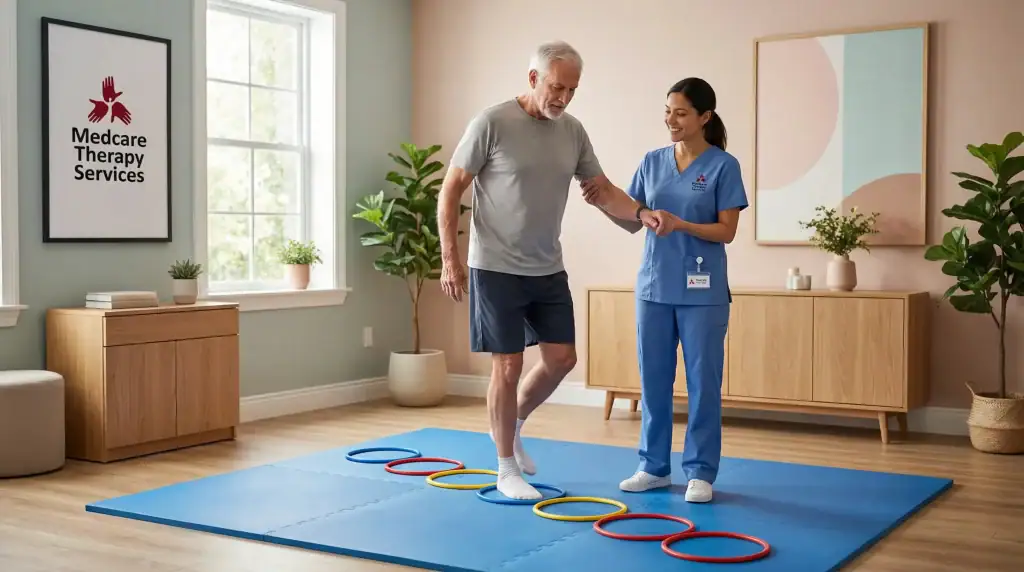
Gait training helps you relearn proper walking mechanics after stroke, surgery, or injury. Your walking pattern affects everything from your balance to your confidence moving around your home.

Our physical therapists work with you one-on-one to address muscle weakness, coordination problems, and balance issues that make walking difficult or unsafe. Through targeted exercises and hands-on guidance, we help restore the strength and stability you need to walk independently again.
An older man steps through colorful hoops on a mat as a physical therapist in scrubs supports him. They are in a bright, homey therapy room with plants and a "Medcare Therapy Services" sign, serving Suffolk & Nassau County, NY.

Stroke Gait Recovery

Specialized Stroke Walking Recovery

Stroke affects walking in unique ways that require specialized treatment approaches. Many stroke survivors develop compensatory movement patterns that can actually make walking less safe over time.

Our therapists understand how stroke impacts your nervous system and muscle control. Medcare Therapy Services uses proven techniques to retrain your brain-muscle connections, helping you regain more normal walking patterns. This isn’t just about getting you moving again – it’s about helping you walk in a way that prevents future problems and keeps you independent longer.

Gait Training Benefits

What You'll Gain From Treatment

Our professional gait training addresses the root causes of walking problems to restore your mobility and confidence.

Home Gait Training

Convenient Care In Your Home

Home-based gait training offers advantages you can’t get in a clinic setting. You practice walking in the environment where you actually live, dealing with your specific challenges like stairs, doorways, and furniture placement.

Your therapist evaluates how you move through your daily routine and addresses real-world obstacles. We work on practical skills like getting out of bed safely, walking to the bathroom at night, and navigating your kitchen. This practical approach helps ensure the improvements you make during therapy actually translate to better daily living.
Get Care Started Today

Schedule an in-home evaluation with a licensed therapist and receive personalized care designed to improve mobility, safety and independence.

Common questions about Gait Training

Most patients begin noticing improvements in balance and confidence within 2-3 weeks of starting gait training. Significant changes in walking pattern and strength typically develop over 6-8 weeks with consistent therapy. The timeline varies based on your specific condition – stroke recovery may take longer than post-surgical rehabilitation. Your therapist will track your progress and adjust the treatment plan as you improve. Medicare typically covers 12-18 visits within a 4-6 week period, which provides enough time for meaningful improvement in most cases.
Gait training is most effective for people recovering from stroke, hip or knee replacement surgery, leg fractures, or those experiencing balance problems due to aging. Patients with neurological conditions like Parkinson’s disease or multiple sclerosis also see significant benefits. Anyone who has developed an abnormal walking pattern due to pain, injury, or prolonged immobility can benefit from professional gait training. The key is that your walking problems must be treatable through exercise and retraining – your therapist will determine if gait training is appropriate during the initial evaluation.
Yes, Medicare Part B covers medically necessary gait training when provided by licensed physical therapists in your home. You’ll need a physician’s order certifying that you require skilled therapy services. Medicare covers up to $2,410 annually before requiring additional documentation, and there’s no limit on the number of sessions if they remain medically necessary. You’ll pay 20% coinsurance after meeting your Part B deductible. Most patients qualify if they have difficulty walking safely or have experienced a recent decline in mobility due to medical conditions.
Home gait training allows you to practice in your actual living environment, addressing real challenges like your specific stairs, floor surfaces, and room layouts. Your therapist can evaluate safety hazards in your home and teach you to navigate them properly. There’s no travel required, which is especially important if transportation is difficult. You also get more personalized attention without the distractions of a busy clinic. The familiar environment often helps patients feel more comfortable and confident during treatment, leading to better outcomes.
You should consider gait training if you’ve noticed changes in how you walk, frequent stumbling or near-falls, difficulty with stairs or uneven surfaces, or if walking has become more tiring than usual. Recent surgery, stroke, or injury that affected your mobility are clear indicators for professional help. If family members have commented on changes in your walking or if you’ve started using walls or furniture for support, these are signs that gait training could help. Your doctor can evaluate whether you’d benefit from therapy and provide the necessary referral.
Your first session focuses on comprehensive evaluation of your walking pattern, balance, strength, and mobility challenges. We will watch you walk, test your balance in different positions, and assess muscle strength in your legs and core. We’ll ask about your medical history, current symptoms, and specific goals for treatment. You’ll discuss any falls or near-falls you’ve experienced and identify areas of your home that feel unsafe. Based on this assessment, your therapist will explain their findings and outline a treatment plan tailored to your specific needs and goals.
Need more information?
Where Would You Like to Receive Care?
Select the most convenient option for your therapy needs
In-Home Services
Personalized care delivered to the comfort of your home
Smithtown
Our flagship facility with state-of-the-art equipment
Speonk
Convenient East End location serving the Hamptons area