
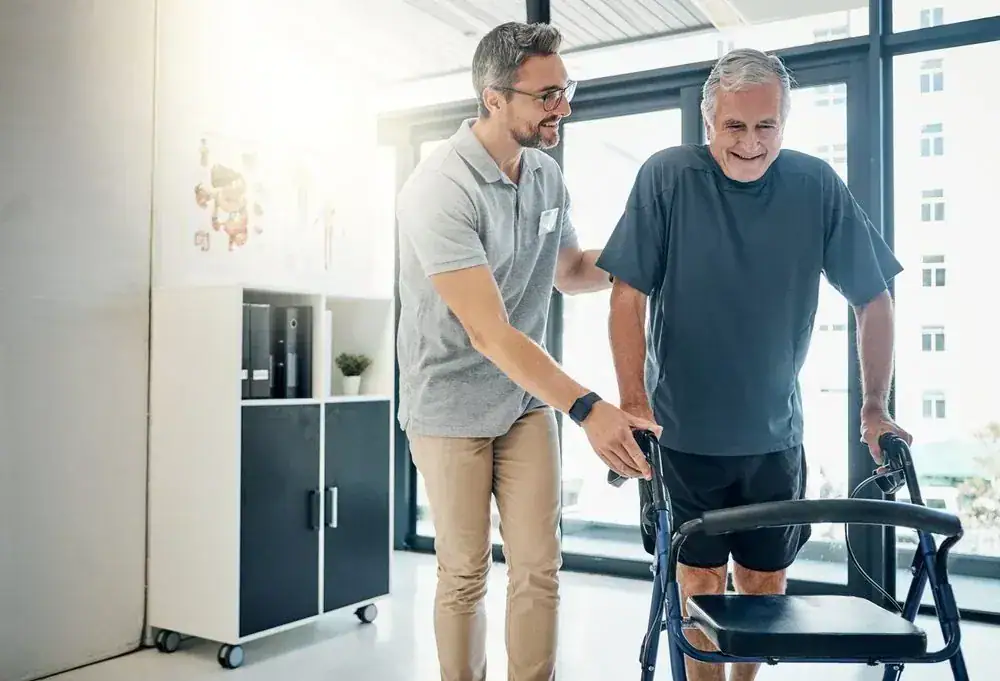

You’ve already limited where you go. Maybe you stopped reaching for things on high shelves, or you avoid the stairs when you can. That hesitation builds on itself until your world gets smaller.
Physical therapy for balance changes that. You work with a licensed therapist who comes to your home and builds a program around how you actually move each day. The exercises aren’t generic—they’re based on what makes you unsteady right now, whether that’s weak legs, poor coordination, or just not trusting your body anymore.
Most people see improvement within a few weeks. Your legs feel steadier. You stop grabbing for the wall every time you stand up. You start doing things you’d been avoiding—walking to the mailbox, getting dressed without sitting down, moving around your kitchen without planning every step.
That’s what elderly fall prevention looks like when it’s done right. You’re not just checking a box. You’re getting your confidence back.
We’ve been providing in-home therapy across Nassau County for over 15 years. We’re Medicare-certified, which means your treatment is covered under outpatient physical and occupational therapy benefits.
Our therapists are trained in the Otago fall prevention program, one of the few approaches with actual research showing it works. We don’t guess at what might help—we follow protocols that have been tested on thousands of older adults and proven to reduce falls by up to 33%.
South Valley Stream has a median age of 43.9, but over 15% of residents in the broader Valley Stream area are over 65. That’s a community where fall prevention matters. We’ve worked with families here who were dealing with the same fears you might be facing—how to stay home safely, how to avoid another trip to the ER, how to stop feeling fragile every time you move.

First, a licensed physical or occupational therapist comes to your home for an assessment. They watch how you walk, how you get up from a chair, how you move through the rooms where you spend your time. They also look at things like lighting, rugs, clutter—anything that could trip you up.
Then they build a program. It usually includes senior balance exercises you can do at home, gait training to improve how you walk, and strength work for your legs and core. Everything is customized based on what they saw during the assessment.
You’ll have regular sessions, typically one to three times a week depending on your needs and what Medicare approves. Your therapist adjusts the program as you get stronger. They also teach you how to keep progressing on your own between visits.
The goal isn’t just to make you stronger. It’s to reduce your actual risk of falling and give you the confidence to move without fear. Most programs run 6 to 12 weeks, but some people need more or less time depending on where they start.

Ready to get started?
Your therapy includes a full fall risk assessment that looks at strength, balance, gait, vision, medications, and home safety. A lot of people don’t realize that certain medications increase fall risk, or that something as simple as poor lighting in the hallway is a problem.
You’ll get a personalized exercise plan with balancing exercises that match your current ability. If you’re already unsteady, you’re not going to start with anything risky. The exercises progress as you improve, and your therapist shows you exactly how to do them safely.
Gait training is a big part of the program. Many older adults develop walking patterns that actually increase fall risk—short steps, shuffling, leaning forward. Your therapist retrains those patterns so you walk in a way that’s more stable and efficient.
In Nassau County, where the median household income in South Valley Stream is over $138,000, many families are looking for quality care that doesn’t require a facility. In-home therapy gives you that. You’re in your own space, working on the specific challenges you face in the environment where falls are most likely to happen. And because we’re Medicare-certified, the cost is covered under your benefits—no out-of-pocket expense for most patients.

Research shows that structured fall prevention programs can reduce falls by up to 33%. The Otago program, which we use, has been tested in multiple studies and consistently shows strong results.
But effectiveness depends on whether you actually do the exercises. The therapist can give you the best program in the world, but if you don’t follow through between sessions, it won’t work. That’s why in-home therapy often gets better results—you’re learning exercises in the same space where you’ll be doing them on your own.
Most people start seeing improvements in balance and strength within 3 to 4 weeks. That doesn’t mean you’re done at that point, but it’s enough progress that you start feeling more confident. The full program usually runs 8 to 12 weeks, depending on your starting point and how quickly you improve.
Yes, if it’s medically necessary. Medicare Part B covers outpatient physical therapy and occupational therapy when a doctor orders it and a licensed therapist provides it.
Fall prevention qualifies as medically necessary if you have a history of falls, balance problems, gait issues, or other risk factors. Your doctor writes a prescription, we handle the authorization with Medicare, and you start therapy. Most patients pay nothing out of pocket after their deductible is met.
There are annual caps on therapy services, but Medicare often grants exceptions if you need more sessions. We track your progress and work with your doctor to make sure you’re getting the care you need without running into coverage issues. The key is documentation—we have to show that therapy is improving your function and reducing your fall risk.
It depends on your current ability, but most programs include exercises that challenge your balance in safe, controlled ways. You might start with something as simple as standing on one foot while holding a counter, then progress to doing it without support.
Heel-to-toe walking is common—it improves your stability and coordination. Sit-to-stand exercises build leg strength, which is critical for preventing falls. Weight shifts, where you practice moving your body weight from one leg to the other, help with balance during everyday activities like reaching or turning.
As you get stronger, the exercises get harder. You might add head turns while walking, or practice stepping over objects, or do balance work on different surfaces. Everything is designed to mimic real-world challenges so you’re better prepared when you encounter them outside of therapy. Your therapist demonstrates each exercise, watches you do it, and makes sure you can perform it safely on your own.
Most people notice a difference within the first month. Your legs feel stronger, you’re steadier when you walk, and you’re not as worried about losing your balance. But “results” means different things depending on where you start.
If you’re recovering from a fall and very deconditioned, it might take 8 to 12 weeks to get back to a safe level of function. If you’re generally healthy but starting to feel unsteady, you might see significant improvement in 4 to 6 weeks.
The research on fall prevention programs shows that the benefits continue even after therapy ends, as long as you keep doing the exercises. That’s the goal—to give you a routine you can maintain on your own. Your therapist will work with you until you’re strong enough and confident enough to continue without regular supervision. Some people need a few tune-up sessions down the road, and that’s fine. The important thing is that you’re moving better and falling less.
The therapist spends about an hour evaluating your fall risk. They ask about your history—have you fallen before, do you feel unsteady, are you afraid of falling, what medications are you taking. Then they watch you move.
They’ll have you walk across the room, turn around, sit down, stand up. They’re looking at your gait, your balance, your strength, and how you transition between positions. They might test your reaction time or see how well you can stand on one foot. They also walk through your home looking for hazards—loose rugs, poor lighting, clutter, lack of grab bars.
At the end of the visit, they explain what they found and what the plan is. You’ll usually start with a few simple exercises right away, and they’ll schedule your next session. The goal of that first visit is to understand your specific risks so the program can address them directly. It’s not a generic approach—it’s based on what’s actually making you unsteady.
Yes, but you need to address it quickly. Falling once doubles your risk of falling again, and each fall makes the next one more likely. That cycle is what we’re trying to break.
If you’ve had multiple falls, the therapy will likely be more intensive. Your therapist will look closely at what’s causing the falls—is it muscle weakness, poor balance, vision problems, medication side effects, environmental hazards, or a combination of factors. Then they build a program that addresses each issue.
You might need more sessions per week at the start, and the program might run longer than it would for someone who’s just starting to feel unsteady. But the research is clear—structured fall prevention therapy works even for people with a significant fall history. The key is committing to the program and doing the work between sessions. Your therapist will push you, but only in ways that are safe and appropriate for your current level. The goal is to rebuild your strength and confidence so you can move through your home without fear.
Other Services we provide in South Valley Stream