
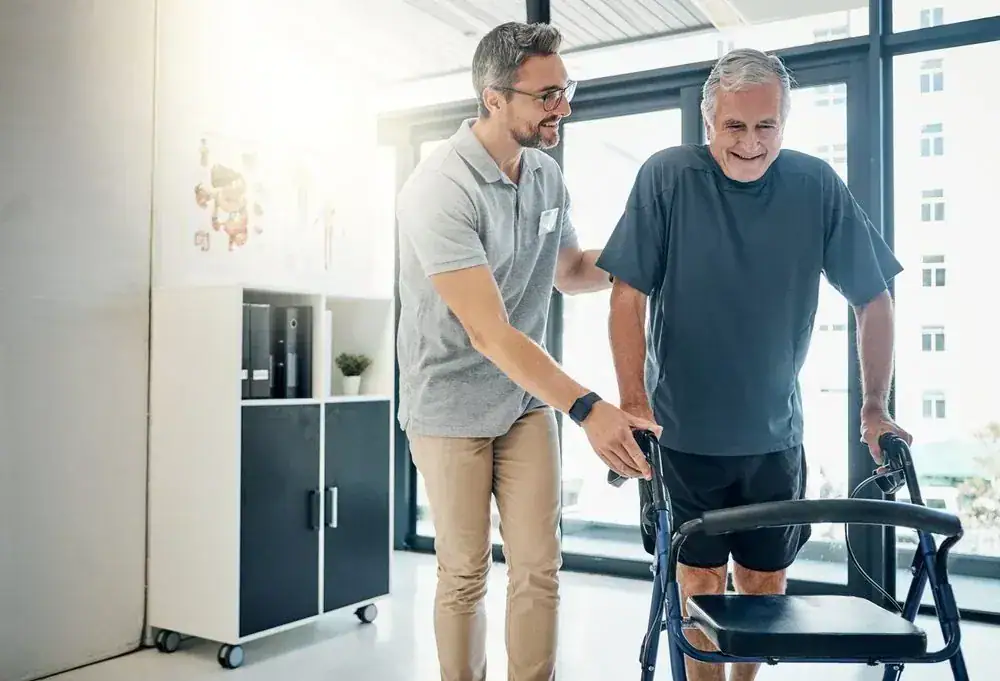

You stop second-guessing every step. Getting up from a chair, walking to the mailbox, moving around your kitchen—these everyday movements become automatic again instead of calculated risks.
That’s what balance training does. It rebuilds the strength in your legs and core, sharpens your coordination, and gives your body the stability it needs to catch itself before a fall happens. Research shows that structured programs like the Otago Exercise Program can reduce falls by 35-40% in older adults, and those improvements can last up to a year after training ends.
This isn’t about wrapping yourself in bubble wrap or avoiding activity. It’s about training your body to handle real-world movement so you can keep doing what matters to you without fear hanging over every step.
We’ve been providing in-home physical therapy across Long Island for over 14 years. We specialize in fall prevention because we’ve seen what happens when it’s ignored—and what’s possible when it’s done right.
Riverhead has one of the highest senior populations on Long Island, with nearly 28% of residents over 65. That’s almost double the national average. Falls are the leading cause of injury-related hospitalizations in this age group, and Nassau and Suffolk counties rank among the highest in New York State for fall-related incidents.
We work with you in your home because that’s where most falls happen—and where the training matters most. Our therapists are trained in evidence-based programs like Otago, and every plan is built around your specific risks, your goals, and your environment.

It starts with a fall risk assessment in your home. A licensed physical therapist evaluates your strength, balance, gait, and the layout of your space. They’re looking for specific factors—weak legs, poor coordination, tripping hazards, lighting issues—that increase your risk.
From there, they build a personalized exercise program. This typically includes balance exercises for seniors, lower body strengthening, gait training, and functional movements that mimic what you do every day. You’re not doing generic stretches. You’re training your body to respond to real situations—stepping over objects, recovering from a stumble, getting up safely.
Sessions happen in your home, usually 1-2 times per week depending on your needs. Your therapist tracks your progress, adjusts exercises as you improve, and teaches you how to continue training independently. Most programs run 8-12 weeks, but the skills and strength you build carry forward long after therapy ends.

Ready to get started?
You get a comprehensive fall risk assessment that identifies your specific vulnerabilities—muscle weakness, balance deficits, vision issues, medication side effects, or environmental hazards in your home. This isn’t a checklist. It’s a detailed evaluation by a licensed therapist who knows what to look for.
Your program includes targeted balance exercises, strength training for your legs and core, gait training to improve how you walk, and functional movement practice. These aren’t random exercises. They’re evidence-based techniques proven to reduce fall risk in older adults, and they’re customized to match your current ability level.
In Riverhead and across Suffolk County, falls account for a significant portion of emergency department visits and hospitalizations among seniors. The good news? Studies show that physical activity—especially leg strength and balance training—can reduce fall risk by 30-50%. That’s not a small number. That’s the difference between staying independent and losing it.
Most fall prevention therapy is covered by Medicare when prescribed by a physician and delivered by a licensed therapist. We handle the paperwork and verification so you can focus on the work that matters.

If you’ve fallen in the past year, you’re already at higher risk. If you feel unsteady on your feet, avoid certain activities because you’re afraid of falling, or you’ve noticed your balance isn’t what it used to be—those are signs worth addressing.
Other red flags include difficulty getting up from a chair without using your arms, trouble walking on uneven surfaces, dizziness or lightheadedness when standing, or taking medications that affect balance (like blood pressure meds or sedatives). Even if you haven’t fallen yet, these factors increase your risk significantly.
A physical therapist can assess your fall risk through specific tests—measuring your leg strength, checking how you walk, testing your balance in different positions. If you’re unsure, it’s worth getting evaluated. Catching these issues early makes them much easier to fix than waiting until after a fall puts you in the hospital.
The exercises depend on your current ability, but most programs include standing balance drills, weight shifting, single-leg stands, heel-to-toe walking, and controlled movements that challenge your stability. You might practice stepping over objects, reaching in different directions while standing, or getting up and down from a chair safely.
Strengthening exercises focus on your legs—squats, leg lifts, calf raises, step-ups. These build the muscle power you need to catch yourself if you start to fall. Gait training improves how you walk—your stride length, foot placement, and rhythm. All of this gets harder progressively as you improve.
The Otago Exercise Program, which our therapists are trained in, has been studied extensively and shown to reduce falls by 35-40% in older adults. It’s not flashy, but it works because it targets the exact physical deficits that cause falls. You’ll also get exercises you can do on your own between sessions to keep building strength and balance.
Yes, Medicare Part B covers outpatient physical therapy when it’s medically necessary and prescribed by a doctor. Fall prevention therapy qualifies if you have documented fall risk factors—previous falls, balance problems, gait issues, or conditions that affect mobility.
Your physician needs to refer you for therapy, and a licensed physical therapist must provide the treatment. Medicare covers a portion of the cost after you meet your deductible, and there’s typically a copay for each session. The exact coverage depends on your specific plan and whether you’ve hit any therapy caps for the year.
We verify your Medicare coverage before starting treatment so there are no surprises. Most patients with fall risk factors get approved without issue. If you have a Medicare Advantage plan, coverage rules may differ slightly, but fall prevention therapy is generally included because it’s considered preventive care that reduces more expensive hospitalizations down the road.
Because most falls happen at home. Training in the environment where you actually live lets your therapist identify real hazards—loose rugs, poor lighting, awkward furniture placement, bathroom risks—and teach you how to navigate your specific space safely.
In-home therapy also removes transportation barriers. For seniors with mobility issues, getting to a clinic can be difficult, stressful, or even impossible. When therapy comes to you, you’re more likely to stick with the program and see results.
There’s also a practical element: your therapist can assess how you move in your actual daily routine. They see how you get in and out of your bed, navigate your stairs, move around your kitchen. That context matters. Exercises and modifications can be tailored to your real life, not a generic clinic setup. Plus, for many Riverhead residents—especially those in more rural areas or without reliable transportation—in-home care is simply more accessible and realistic.
Most people start noticing improvements in balance and confidence within 4-6 weeks of consistent therapy. Strength takes a bit longer—usually 8-12 weeks to see measurable gains in leg power and stability. The full program typically runs 8-12 weeks with 1-2 sessions per week, depending on your needs.
Research shows that balance improvements from structured training can last up to a year after you finish therapy, especially if you continue doing maintenance exercises on your own. The key is consistency. Skipping sessions or not practicing between visits slows progress significantly.
Your therapist will track specific metrics—how long you can stand on one leg, how fast you walk, how many times you can sit and stand from a chair in 30 seconds. These aren’t arbitrary tests. They’re proven indicators of fall risk, and watching those numbers improve gives you concrete proof that the work is paying off. The goal isn’t just to finish therapy. It’s to build habits and strength that keep you stable long after sessions end.
Absolutely. In fact, falling once significantly increases your risk of falling again, so addressing it quickly matters. Post-fall therapy focuses on rebuilding strength, restoring confidence, and identifying what caused the fall so it doesn’t happen again.
Many people develop a fear of falling after an incident, which leads to reduced activity, which leads to weaker muscles and worse balance—a dangerous cycle. Physical therapy breaks that cycle by gradually rebuilding your physical capacity and your trust in your body’s ability to move safely.
Your therapist will assess any lingering effects from the fall—weakness, pain, limited range of motion—and design a program that addresses those issues while also preventing future falls. This might include balance retraining, strengthening exercises, gait correction, and environmental modifications. The earlier you start after a fall, the better your chances of full recovery and avoiding another incident. Waiting only makes the problem harder to fix.
Other Services we provide in Riverhead