
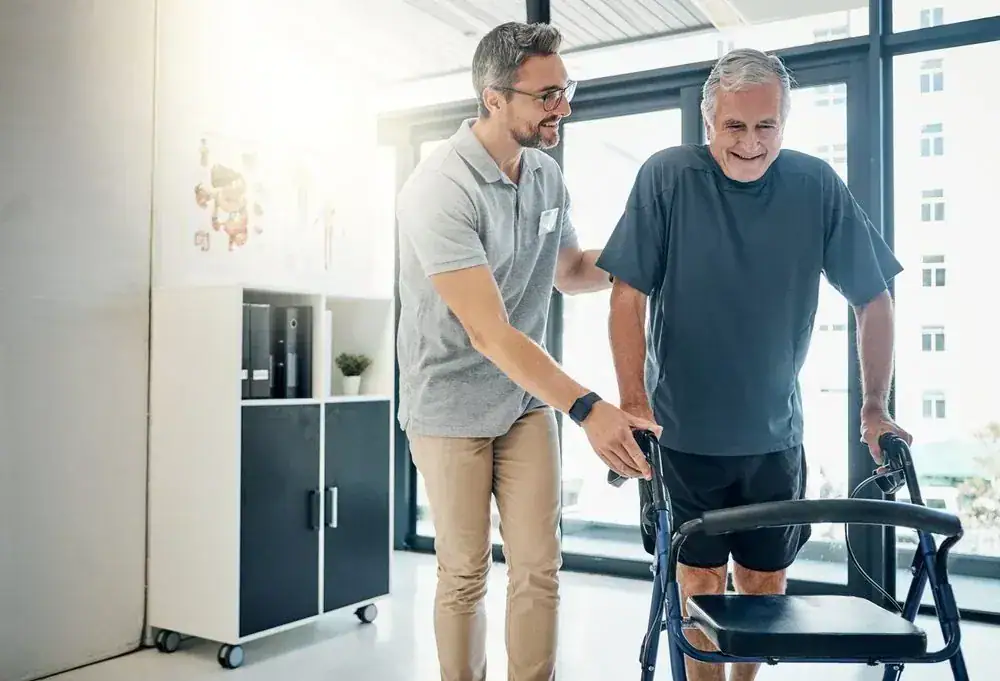
You’ve already fallen once, or you’re worried it’s coming. That fear changes everything—how you move around your kitchen, whether you go outside, if you’ll need to leave your home for assisted living.
Here’s what actually works: balance exercises for seniors that target the specific weaknesses causing instability. Not generic stretches. Not one-size-fits-all videos. A licensed physical therapist assesses your exact risk factors in your actual home environment and builds a program around what your body needs.
Research shows the right elderly fall prevention program cuts your fall risk by 23 to 35 percent. You get stronger legs, better coordination, faster reaction time. You stop second-guessing every step. The program happens in your home, so there’s no commute to a clinic when you’re already unsteady. Medicare covers it when you work with licensed providers. You just need someone who knows what they’re doing.
We’ve been delivering home-based physical therapy across Long Island for 15 years. We’re not a new operation trying to figure things out. We’re licensed, Medicare-certified therapists who’ve built hundreds of personalized fall prevention programs for people just like you.
Belle Terre has one of the highest senior populations on Long Island—over 30 percent of residents are 65 or older. You’re not alone in dealing with balance issues or fall anxiety. Nassau County ranks fourth in New York State for fall-related hospitalizations among older adults. This is a real problem here, and we’ve been addressing it locally since 2010.
Every therapist on our team is verified, background-checked, and trained in evidence-based fall prevention methods. Your information stays secure. Your care stays consistent. You’re not handed off to whoever’s available that week.

First, a licensed physical therapist comes to your home and does a full fall risk assessment. They watch how you walk, test your balance, check your strength and flexibility, and look at your actual living space for hazards. This isn’t a questionnaire. It’s a functional evaluation of what’s putting you at risk right now.
Then they build your program. It’s usually a combination of strength training for your legs and core, balance exercises that challenge your stability in safe progressions, and coordination drills that improve reaction time. Everything is tailored to your current ability level. If you’re using a walker, that’s where you start. If you’re steady but nervous, they’ll push you a bit further.
Sessions happen one-on-one in your home, typically two to three times per week for several weeks. Your therapist tracks your progress, adjusts exercises as you improve, and teaches you what to keep doing on your own. Many patients see measurable improvement within four to six weeks—better balance scores, stronger legs, less fear. You’ll know if it’s working because you’ll feel the difference when you move.

Ready to get started?
You get a licensed physical or occupational therapist who specializes in senior balance exercises and fall prevention. They bring all necessary equipment to your home—resistance bands, balance tools, whatever’s needed for your specific program.
Your program typically includes strengthening exercises that target the muscles you actually use to catch yourself when you stumble. Balance training that mimics real-world challenges like uneven surfaces, turning quickly, or reaching for something. Flexibility work to improve your range of motion. Gait training if your walking pattern is contributing to instability.
In Belle Terre and across Nassau County, falls send more seniors to the hospital than any other injury. 88 percent of injury hospitalizations for adults over 65 here are fall-related. Your therapist knows these statistics and treats your program with the urgency it deserves. They’ll also educate your family members on how to support your progress and what warning signs to watch for.
This is Medicare-covered outpatient therapy when medically necessary and prescribed by your doctor. No surprise bills. No fighting with insurance after the fact. We verify your coverage before starting and handle the billing directly.

Yes, if it’s medically necessary and prescribed by your doctor. Medicare Part B covers outpatient physical therapy when a licensed therapist provides it and documents your need based on fall risk, previous falls, balance deficits, or mobility limitations.
You’ll need a referral or prescription from your physician stating that you require physical therapy for balance or fall prevention. Your therapist will do an initial evaluation to establish baseline measurements and create a treatment plan. As long as you’re showing improvement and the therapy is reasonable and necessary, Medicare continues coverage.
There are annual caps, but exceptions exist for patients who need extended care. Most fall prevention programs run eight to twelve weeks with two to three sessions per week. We verify your specific coverage before your first appointment so you know what to expect. No guessing about costs after the fact.
Most patients notice changes within three to four weeks if they’re consistent with their program. You might feel steadier when you stand up from a chair, more confident on stairs, or less wobbly when you turn your head while walking.
Measurable improvements on balance tests typically show up around the four to six week mark. Your therapist will retest you periodically using the same assessments from your initial evaluation—things like how long you can stand on one foot, how quickly you can sit and stand five times, or how far you can reach without losing balance. Studies show balance scores can improve 16 to 42 percent compared to baseline after a structured program.
The key is doing your exercises between therapy sessions. If your therapist gives you homework and you skip it, your progress slows. If you practice daily, even for 10 to 15 minutes, you’ll see faster results. This isn’t passive treatment where someone does something to you. It’s active training where you’re building new strength and coordination.
No. Falling once doubles your risk of falling again, but that also means intervention makes an even bigger difference for you. You’re exactly who these programs are designed for.
Multiple falls usually mean there are several contributing factors—weak legs, poor balance, medication side effects, vision issues, home hazards. A good fall prevention program addresses all of them. Your therapist will work with your doctor if medications need review. They’ll identify hazards in your home. They’ll build strength and balance through targeted exercises.
The evidence is clear: structured physical therapy reduces fall risk by 23 to 35 percent even in people who’ve already fallen. You’re not too far gone. You’re not too old. Your body can still build strength and improve coordination if you give it the right stimulus. It takes longer if you’re starting from a weaker baseline, but improvement is absolutely possible. Many of our patients who’d fallen multiple times go months or years without another fall after completing their program.
You need a therapist to assess your specific risk factors and prescribe the right exercises at the right difficulty level. Generic online videos can’t do that.
Here’s why: if your falls are caused by weak hip muscles, you need different exercises than someone whose falls are caused by inner ear problems or neuropathy in their feet. If you do exercises that are too easy, you won’t improve. If you do exercises that are too hard or use poor form, you could actually increase your fall risk or hurt yourself.
A licensed physical therapist evaluates your strength, balance, flexibility, gait pattern, and home environment. They identify your specific deficits and build a progression that challenges you safely. They watch your form and correct it. They progress you to harder variations as you improve. They know when to push and when to pull back.
The Otago Exercise Program, one of the most researched fall prevention programs, requires a trained therapist to prescribe and monitor it properly. That’s not accidental. Professional guidance is what makes these programs effective. Once you’ve completed your therapy and learned proper technique, then you can maintain your gains with home exercises. But skipping the professional assessment up front means you’re guessing about what you actually need.
Your therapist arrives at your home at the scheduled time with any equipment needed for the evaluation. They’ll start by asking about your fall history—when you fell, what you were doing, whether you got hurt, if you’re afraid of falling again. They’ll review your medications and medical conditions that might affect balance.
Then comes the physical assessment. They’ll watch you walk, test how long you can stand on one foot, see if you can stand from a chair without using your hands, check your leg strength and flexibility, and evaluate your reaction time. They might test your vision and proprioception—your body’s sense of where it is in space. They’ll also walk through your home looking for hazards like loose rugs, poor lighting, or lack of grab bars.
After the evaluation, they’ll explain what they found and what your program will look like. How many sessions per week, what types of exercises, what goals you’re working toward. You’ll usually start some exercises right there in the first session so they can teach proper form. The whole appointment takes about an hour. You’ll leave with a clear plan and often some exercises to practice before the next session.
If you’re already unsteady or nervous about falling, getting to and from a clinic adds risk and stress you don’t need. Home therapy eliminates that barrier completely.
Your therapist sees exactly where you live and move every day. They can spot hazards in your actual environment—the rug that slides, the step you struggle with, the bathroom layout that’s awkward. They can practice the specific movements you do daily, like getting in and out of your own shower or navigating your own stairs. That’s more functional than generic exercises in a clinic gym.
You also get one-on-one attention for the full session. No sharing your therapist’s time with two other patients. No waiting for equipment. No feeling rushed. For many Belle Terre residents, especially those living alone or without easy transportation, home therapy is the difference between getting treatment and skipping it entirely.
The outcomes are just as good—often better—than clinic-based therapy for fall prevention. You’re more likely to stick with the program when it’s convenient. You’re more likely to continue your exercises after therapy ends because you’ve practiced them in the space where you’ll keep doing them. Convenience matters, but so does the quality of care you get at home.
Other Services we provide in Belle Terre