
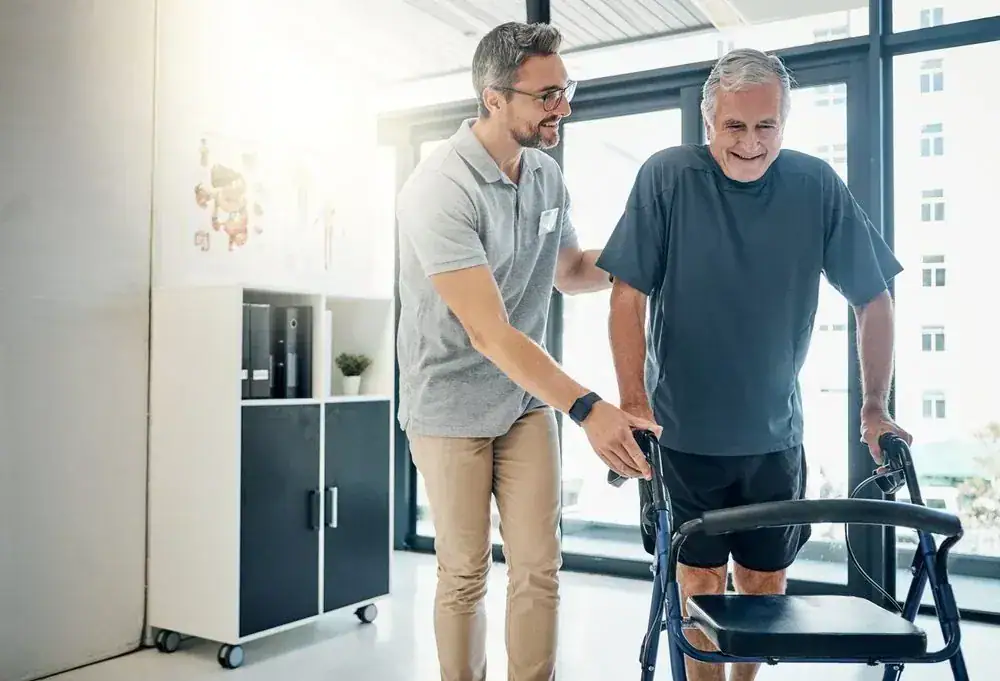
You stop second-guessing every step. Getting up from a chair doesn’t require a strategy session. Walking to the mailbox or down your hallway feels normal again, not like navigating a tightrope.
That’s what happens when balance training actually works. Your legs remember how to catch you. Your body relearns what stable feels like. You move through your day without that constant background hum of worry.
Falls aren’t random. They happen because strength fades, reflexes slow, and the small stabilizing muscles stop firing the way they used to. Physical therapy for balance rebuilds those systems. You get stronger in the places that matter most for staying upright. Your gait improves. Your confidence comes back.
And here’s the part that matters if you’re trying to stay in your own home: you don’t have to leave it to make this happen. Everything we do happens in your space, with your furniture, on your floors. That’s where real-world balance gets built.

First visit takes about 45 to 60 minutes. A licensed physical therapist comes to your home and does a full evaluation. They’ll watch how you walk, test your balance, check your strength, and ask about any falls or close calls you’ve had. They’re also looking at your environment—rugs, lighting, furniture placement, anything that might be adding to your risk.
From there, they build a treatment plan. It’s not generic. It’s based on what your body needs and what your goals are. Maybe you want to feel safer in the shower. Maybe you want to keep gardening. Maybe you just want to stop feeling like you’re one wrong step away from the emergency room.
Sessions usually happen two to three times a week. You’ll do balance exercises, gait training, and strengthening work. Some of it might feel simple at first—standing on one leg, walking heel to toe, shifting your weight. But these are the movements that retrain your body to catch itself. Over time, you’ll add resistance, change surfaces, and challenge your stability in controlled ways.
Between visits, you’ll have exercises to do on your own. They’re not complicated, but they need to be done. That’s how progress happens. Your therapist will adjust things as you improve, and they’ll keep working with you until you hit your goals or plateau.

Ready to get started?
You get one-on-one time with a licensed physical therapist who specializes in elderly fall prevention. Every session is in your home. No driving, no parking, no waiting rooms.
The program includes balance and proprioceptive training, which is just a fancy way of saying we help your body understand where it is in space. You’ll also do gait training to improve how you walk, and therapeutic exercises to rebuild strength in your legs, hips, and core. If you’ve had a stroke or deal with a neurological condition like Parkinson’s, we can fold that into your treatment plan too.
Here’s something that matters for Baywood residents specifically: about 56% of falls happen inside the home. Your bathroom, your kitchen, your bedroom—these are the high-risk zones. We assess those areas and show you how to move through them more safely. We’ll also recommend modifications if needed, but we’re not going to tell you to remodel your whole house.
Medicare covers home-based physical therapy if you meet the criteria, and we accept most commercial insurance plans. If you’re homebound or have significant difficulty leaving your house for medical appointments, there’s a good chance you qualify. We’ll help you figure that out during the first call.
If you’ve already fallen in the past year, your risk is higher. If you’ve had a close call—grabbed a counter, caught yourself on a wall—that counts too. Those near-misses are your body telling you something’s off.
Other signs: you feel unsteady when you stand up. You avoid certain activities because you’re worried about balance. You hold onto furniture when you walk around the house. You take four or more medications, especially anything that affects blood pressure or makes you drowsy. You have a chronic condition like arthritis, Parkinson’s, or osteoporosis.
Age alone doesn’t make you high-risk, but the older you get, the more likely it is that strength, vision, and reflexes have declined. A physical therapist can do a formal fall risk assessment and give you a clear answer. But if you’re asking the question, that’s usually reason enough to get evaluated.
You’re training in the environment where you actually need to be stable. Clinic floors are flat and even. Your house has transitions, rugs, different surfaces, and the specific layout you navigate every day. We can address those exact challenges in real time.
There’s also the practical side. If getting to a clinic is hard—if you don’t drive anymore, or if the trip itself is exhausting—you’re less likely to stick with therapy. Consistency matters more than intensity when it comes to balance training. Showing up three times a week at home is a lot easier than arranging rides and spending two hours round-trip for a 45-minute session.
And for a lot of people, there’s just less stress. You’re in your own space. You’re not worried about falling in a parking lot or navigating a new building. You can focus on the work instead of the logistics.
Most people start noticing small changes within two to three weeks. You might feel more stable getting out of a chair, or notice that you’re not grabbing the wall as much when you walk. Bigger improvements—like measurably better balance or faster walking speed—usually show up around the six-to-eight-week mark.
That said, it depends on where you’re starting from. If you’ve been sedentary for a while or you’re recovering from an injury, it might take longer. If you’re generally active but just need some fine-tuning, you could see results faster.
The research backs this up: balance exercises done at least three days a week for 45 minutes or more significantly reduce fall risk. But you have to stay consistent. Skipping sessions or not doing your home exercises will slow things down. Your therapist will track your progress with objective measures—timed tests, balance assessments—so you’ll know exactly where you stand.
Medicare Part B covers home-based physical therapy if you’re considered homebound and your doctor orders it. Homebound doesn’t mean you can never leave the house. It means leaving requires a lot of effort—you need help, or assistive devices, or the trip is really taxing.
If you qualify, Medicare covers 80% of the approved amount after you’ve met your deductible. You’re responsible for the remaining 20%. There’s no limit on the number of sessions, but therapy has to be medically necessary and show continued progress. Once you plateau or hit your goals, coverage stops.
We handle the paperwork and verify your benefits before we start. If you have a Medicare Advantage plan or supplemental insurance, the coverage might be different, but we work with most plans. The key is getting that physician order and meeting the homebound criteria. If you’re unsure, we can walk through it with you during the initial call.
No. If anything, falling makes therapy more important, not less. A fall increases your fear of falling, which leads to avoiding activity, which leads to getting weaker, which increases your risk of falling again. It’s a cycle, and physical therapy breaks it.
After a fall, we’ll assess any lingering injuries or mobility issues and build a plan around that. If you’re dealing with pain, reduced range of motion, or muscle weakness from the fall, we address those first. Then we move into balance and gait training to reduce the chance of it happening again.
The stats are clear: people who’ve fallen once are two to three times more likely to fall again. But balance training reduces that risk significantly. You’re not starting from scratch—you’re rebuilding systems that used to work. Your body remembers. It just needs the right input to get back on track.
Yes. We treat patients with Parkinson’s, stroke recovery, neuropathy, and other neurological conditions that affect balance and movement. These conditions add complexity, but they don’t disqualify you from therapy. If anything, they make it more necessary.
Neurological rehab focuses on retraining movement patterns and compensating for deficits. If you have Parkinson’s, we’ll work on gait freezing, posture, and movement initiation. If you’ve had a stroke, we’ll address weakness or coordination issues on the affected side. If you have neuropathy, we’ll incorporate sensory training and teach you how to move safely when you can’t fully feel your feet.
The approach is different than standard balance training, but the goal is the same: keep you stable, keep you moving, and reduce fall risk. Our therapists have experience with these conditions and know how to adapt treatment to what your body can do right now.
Other Services we provide in Baywood