
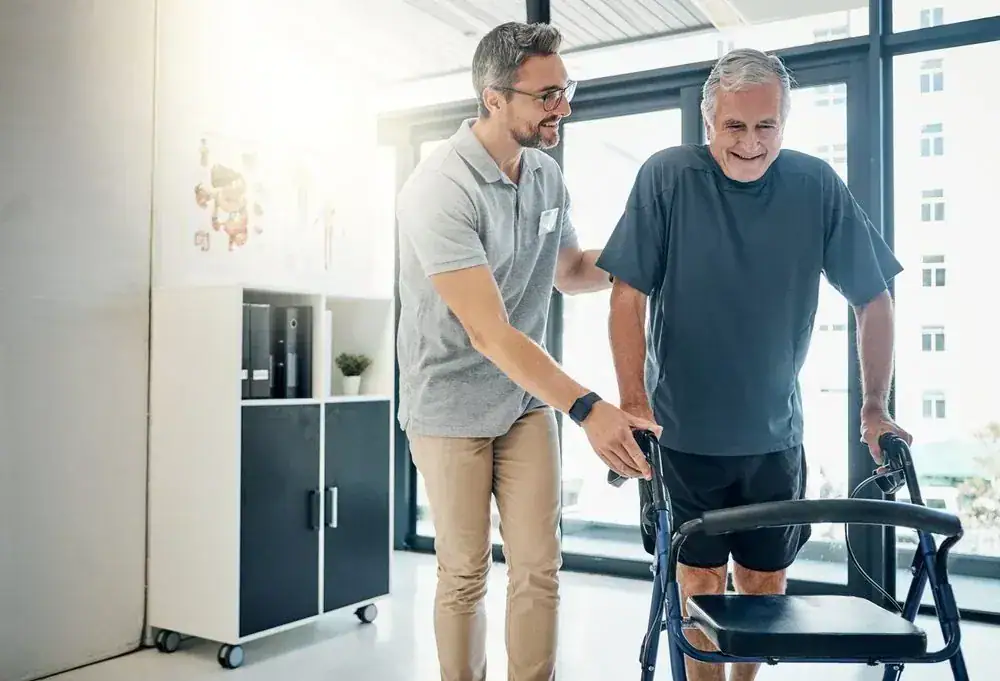
You shouldn’t have to think twice before getting up from your chair or walking to the bathroom at night. That hesitation, that split-second fear before you move—it’s exhausting. And it limits everything you do.
Physical therapy for balance addresses what’s actually causing the problem. Weak legs, poor coordination, medication side effects, or just years of not moving the way you used to. These aren’t things you fix by being more careful. You fix them by rebuilding strength and retraining your body to move with confidence.
Most people start noticing real improvements within four to six weeks. You’ll feel steadier on your feet, more comfortable navigating stairs, and less anxious about moving around your own home. That’s not a promise—it’s what happens when you work with a licensed therapist who knows how to assess your specific risk factors and build a program around them.
We’ve been providing in-home physical therapy across Suffolk and Nassau County for over a decade. That means we’ve worked with hundreds of people in Amagansett and the surrounding Hamptons communities who were dealing with the same concerns you’re facing now.
We accept Medicare and most commercial insurance plans, and our therapists are trained in evidence-based fall prevention programs like the Otago Exercise Program. We don’t just show up and run you through generic exercises. We assess your home, review your medications, evaluate your balance and strength, and build a plan that actually addresses your risk factors.
Long Island has some of the highest fall rates in New York State—Nassau and Suffolk counties rank fourth and fifth statewide. In Nassau County alone, 88% of injury hospitalizations for adults over 65 are fall-related. You’re not being overly cautious by looking into this. You’re being smart.

First, a licensed physical therapist comes to your home and conducts a full fall risk assessment. That includes reviewing your medical history, checking your current medications for side effects like dizziness, testing your balance and gait, and walking through your home to identify hazards you might not have noticed.
From there, your therapist builds a personalized treatment plan. This usually includes strength training for your legs and core, balance exercises tailored to your ability level, gait training to improve how you walk, and recommendations for making your home safer—better lighting, removing tripping hazards, rearranging furniture if needed.
Sessions happen in your home, on your schedule. You don’t need to worry about transportation or getting to an office. Your therapist works with you one-on-one, adjusting the program as you improve. Most people see maximum benefits after eight to twelve weeks, but you’ll likely notice changes much sooner than that.

Ready to get started?
Every program includes a comprehensive fall risk assessment, personalized balance and strength training, gait analysis and correction, and a home safety evaluation. Your therapist will also review your medications with you to identify anything that might be affecting your balance or causing dizziness.
You’ll receive exercises you can do on your own between sessions, along with clear instructions and modifications based on how you’re feeling that day. If you’re recovering from a fall or surgery, or managing a chronic condition like arthritis or Parkinson’s, your program will be adjusted to account for that.
Here in Amagansett and across the Hamptons, many of the homes have stairs, uneven flooring, or layouts that can be tricky to navigate as you age. We understand the local housing stock and will give you practical, realistic recommendations that fit your actual living situation. This isn’t about making you feel bad for how your home is set up—it’s about making small changes that have a big impact on your safety.

Most people begin noticing improvements within four to six weeks of consistent therapy. That might mean you feel steadier when standing up from a chair, more confident on stairs, or less anxious about walking around your home.
Maximum benefits typically show up after eight to twelve weeks, but the timeline depends on your starting point and how consistently you’re able to do the exercises. If you’ve had a recent fall or you’re dealing with significant muscle weakness, it may take a bit longer. Your therapist will track your progress and adjust the program as you improve.
The key is consistency. Physical therapy works, but only if you’re actually doing it. Your therapist will give you exercises to practice between sessions, and those matter just as much as the time you spend together.
Yes. Medicare Part B covers physical therapy when it’s medically necessary, and fall prevention absolutely qualifies—especially if you have a history of falls, balance issues, or difficulty walking. We accept Medicare and nearly all commercial insurance plans.
In New York State, you can receive physical therapy for up to 30 days or 10 visits without a prescription, though most people do get a referral from their doctor. If you’re not sure about your coverage, we can help you verify your benefits before your first session.
Choosing physical therapy to prevent falls can also save you money in the long run. Studies show it saves an average of $2,144 per person when you factor in the cost of hospital visits, rehab, missed activities, and everything else that comes with a serious fall. Prevention is a lot cheaper than recovery.
Absolutely. In fact, having a history of falls is one of the biggest reasons to start therapy now. A previous fall is a major risk factor for falling again, but it also means your body has already shown you where the weak points are.
Physical therapy decreases fall incidents by up to 37% in seniors, and people who start therapy within three months of a fall report significantly lower fall rates up to a year later. Your therapist will figure out what contributed to your fall—whether it was muscle weakness, poor balance, environmental hazards, or a combination—and address those specific issues.
You’re not starting from scratch. You’re taking what happened and using it as information to build a stronger, safer foundation going forward. That’s a smart move, not a reactive one.
The Otago Exercise Program is one of the most researched and proven fall prevention methods available. It was developed specifically for older adults and focuses on strength and balance exercises that directly reduce fall risk.
What makes it different is the structure. It’s not just random exercises—it’s a progressive program that’s tailored to your ability level and adjusted as you get stronger. The exercises target the muscle groups that matter most for balance and mobility: your legs, hips, and core.
Our therapists are trained in Otago and use it as a foundation, but they also customize it based on your specific needs. If you have arthritis, joint pain, or other conditions, the program gets modified. It’s evidence-based, but it’s also flexible enough to meet you where you are.
You could try exercises on your own, but here’s the problem: if you don’t know what’s actually causing your balance issues, you might be working on the wrong things. And if your form is off or you’re doing exercises that aren’t appropriate for your ability level, you could make things worse.
A licensed physical therapist doesn’t just give you exercises. They assess your specific risk factors, test your balance and strength, evaluate how you move, and identify hazards in your home that you might not notice. That’s not something you can do for yourself, and it’s not something a generic online video can replace.
In-home therapy also eliminates the barriers that keep people from getting help—transportation, weather, mobility limitations. Your therapist comes to you, works with you in the environment where you actually live, and gives you a plan that fits your real life. That’s worth a lot more than a list of exercises.
Your first session is mostly assessment. Your therapist will ask about your medical history, any falls you’ve had, medications you’re taking, and what you’re struggling with day-to-day. They’ll also test your balance, watch how you walk, check your strength, and see how easily you can get up from a chair or navigate stairs.
Then they’ll walk through your home with you and point out potential hazards—loose rugs, poor lighting, clutter, furniture placement, anything that could increase your risk. You’re not going to get lectured. It’s a conversation about what’s realistic and what changes would actually make a difference.
By the end of the session, you’ll have a clear picture of where you stand and what the plan is moving forward. You’ll also likely start some light exercises, depending on your ability level. It’s not intimidating, and it’s not about proving anything. It’s about figuring out what you need and getting started.
Other Services we provide in Amagansett