
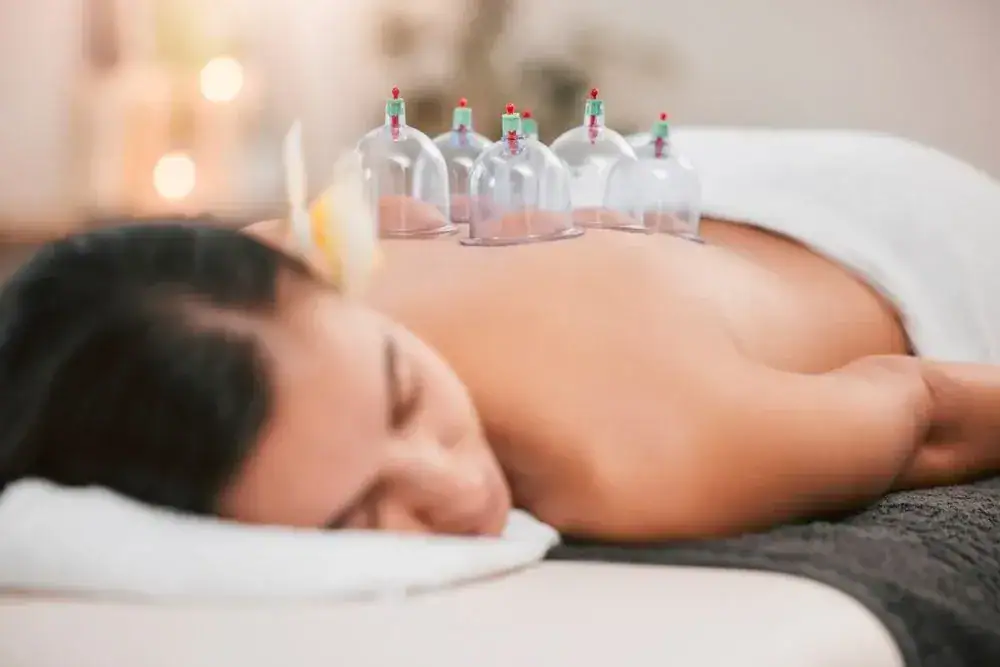

You bend down to pick something up without bracing yourself first. You turn your neck to check your blind spot without that familiar stiffness. You wake up and your lower back doesn’t dictate how the rest of your day goes.
That’s what happens when cupping therapy addresses the muscle tension and restricted blood flow causing your discomfort. The suction created during dry cupping lifts tissue away from underlying structures, mechanically separating fascial layers that have been stuck together. Blood flow to the area increases significantly. Tight muscles release. Your range of motion improves.
Most people notice a difference after their first session. Chronic neck pain, low back pain, and joint stiffness respond particularly well because cupping targets the root cause—not just the symptoms. You’re not masking pain. You’re creating the conditions for your body to move the way it should.
We’ve been providing physical therapy in Freeport and throughout Nassau County since 2010. You’re not a case number here. You’re someone dealing with real pain that’s affecting your daily life, and that matters.
Our team includes licensed physical therapists who integrate cupping into comprehensive treatment plans. Every session is personalized based on what your body needs—not a one-size-fits-all protocol. Our approach combines evidence-based techniques with the kind of attention you’d expect from someone who actually cares whether you get better.
Freeport residents choose us because the focus stays on results. Your treatment plan might include dry cupping along with therapeutic exercise, manual therapy, or other modalities. Whatever combination gets you moving without pain again.
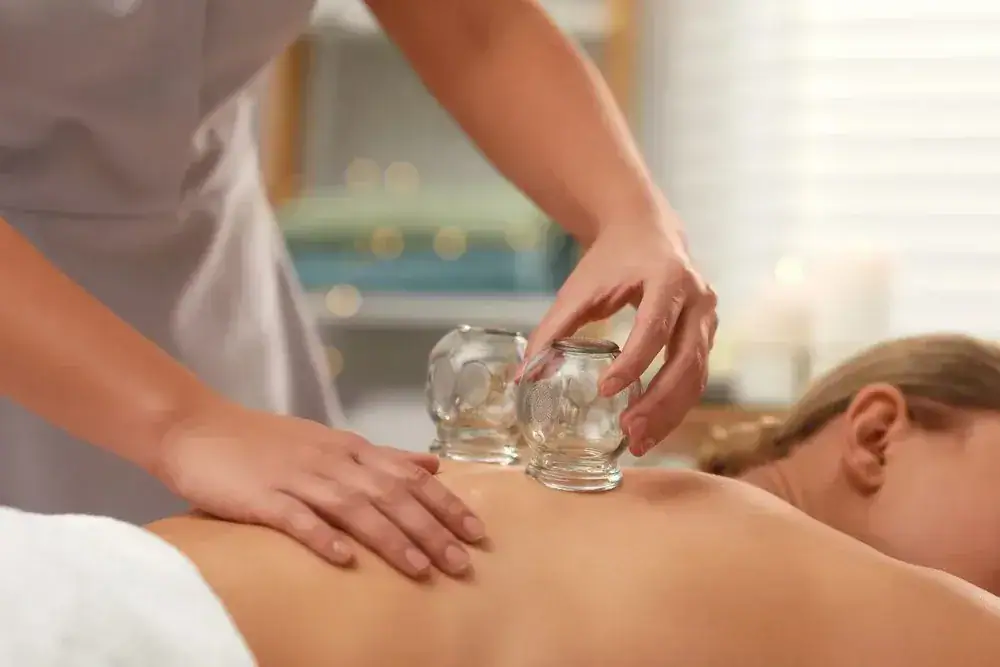
Your physical therapist starts with an assessment. Where’s the pain? What movements make it worse? How long has this been going on? This isn’t small talk—it determines exactly where cups get placed and how much suction to use.
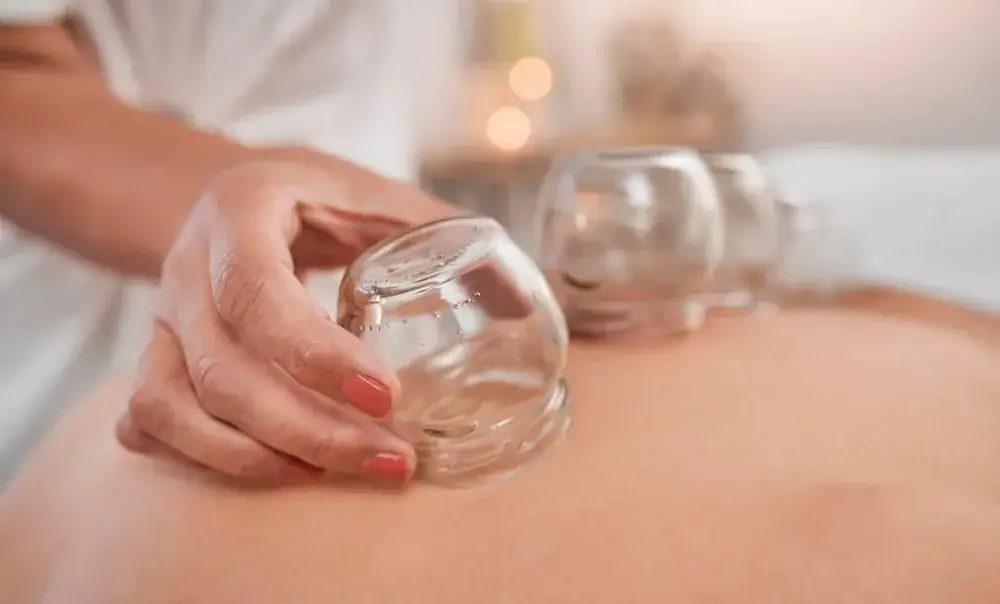
During dry cupping, cups are applied to your skin over the affected area. The suction pulls tissue upward, creating negative pressure that increases blood flow and releases muscle tension. You’ll feel a tight pulling sensation, but it shouldn’t hurt. Most people find it surprisingly comfortable.
Cups typically stay in place for five to fifteen minutes. Some therapists use stationary cupping, while others glide cups across your skin to cover larger areas. After removal, you’ll see circular marks where the cups were—that’s normal and fades within a few days.
The real benefit shows up after. That nagging tightness in your shoulder? Reduced. The limited range of motion in your hip? Improved. Cupping prepares your tissues for the therapeutic exercises that follow, making your entire physical therapy session more effective. You’re not just getting temporary relief—you’re addressing the mechanical restrictions that have been limiting your movement.
Ready to get started?
Chronic low back pain is one of the most common reasons Freeport residents seek cupping therapy. Moderate-quality research supports its effectiveness for reducing pain intensity and improving function. Neck pain responds similarly—especially when muscle tension is the primary driver.
If you’re dealing with limited mobility after an injury, cupping helps. The mechanical lift separates fascial layers and improves scar tissue mobility, which directly impacts how well you can bend, reach, and twist. Athletes use it to decrease post-exercise muscle soreness. Office workers use it for tension headaches caused by tight neck and shoulder muscles.
Joint pain from osteoarthritis, particularly in the hips and knees, often improves with cupping combined with exercise therapy. The increased blood flow and reduced muscle guarding around the joint creates space for movement. You’re not just managing symptoms—you’re restoring function.
Our physical therapists integrate cupping into treatment plans for patients throughout Nassau County. The approach is straightforward: use cupping to prepare tissues, follow with targeted exercises to build strength and stability, then give you the tools to maintain progress at home. No complicated protocols. Just practical treatment that addresses what’s actually causing your pain.
Yes, and the research backs it up. A 2024 systematic review found moderate-quality evidence that cupping reduces pain intensity in people with chronic neck and low back pain. That means multiple well-designed studies showed consistent results—not just anecdotal success stories.
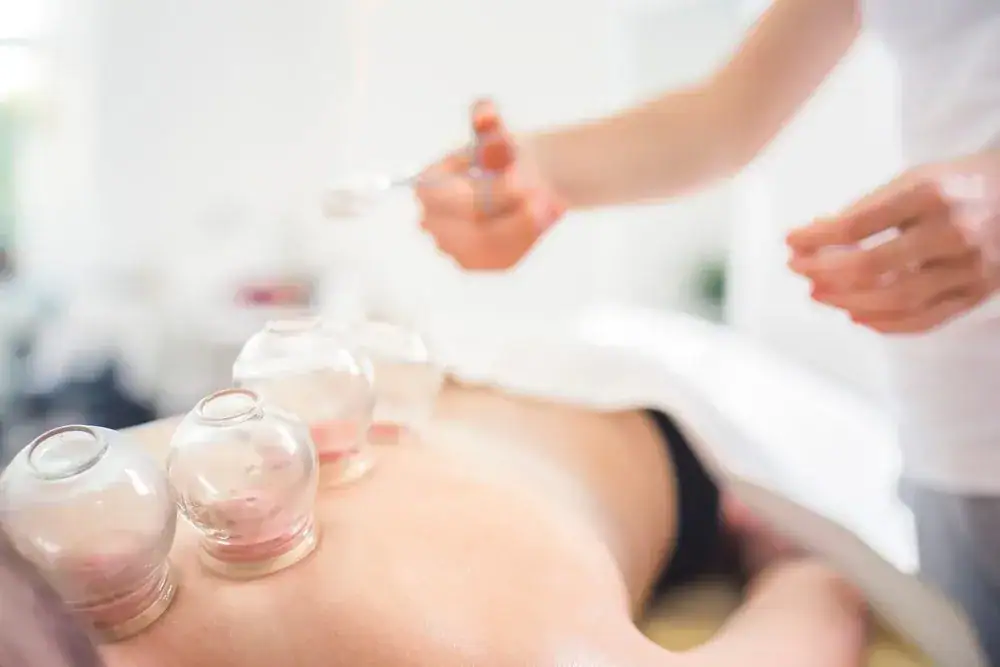
Here’s what happens mechanically: the negative pressure created by cupping increases skin blood flow significantly and lifts fascial layers that have adhered together. When fascia moves freely again, muscles can contract and lengthen properly. That’s why people often notice immediate improvements in range of motion.
Cupping works best as part of a complete treatment plan. Your physical therapist might use it before therapeutic exercises to reduce muscle guarding, making those exercises more effective. Think of it as preparing the soil before planting—you’re creating optimal conditions for the real work of rehabilitation. Most patients in Freeport see the best results when cupping is combined with targeted strengthening and mobility work, not used in isolation.
Dry cupping is what we use, and it’s completely non-invasive. Cups are placed on your skin, suction is created, and that’s it. No needles, no blood, no puncturing of the skin. The suction does all the work by mechanically lifting tissue and increasing blood flow to the area.
Wet cupping involves making small incisions in the skin before applying cups, allowing blood to be drawn out. It’s used in some traditional medicine practices, but it’s not part of standard physical therapy treatment in the United States. The risks are higher, and there’s no evidence it provides better results for musculoskeletal pain.
For pain relief, muscle relaxation, and improved mobility—the reasons most people seek cupping—dry cupping delivers results without any invasive procedures. We use dry cupping exclusively because it’s safer, equally effective for physical therapy goals, and doesn’t require the extended healing time associated with wet cupping. You can return to normal activities immediately after treatment.
Usually three to seven days, depending on how much suction was used and how your body responds. The marks aren’t bruises in the traditional sense—they’re caused by blood being drawn to the surface as capillaries expand under negative pressure. They don’t hurt.
The intensity of the marks doesn’t indicate how effective the treatment was. Some people’s skin marks easily, others barely show discoloration. What matters is how you feel afterward—whether your pain decreased and your movement improved.
If you have an event coming up where the marks would be visible and bothersome, mention it to your physical therapist before treatment. They can adjust cup placement or reduce suction slightly. But most Freeport patients care more about getting rid of their chronic pain than temporary marks that fade quickly. The trade-off is worth it when you can finally move without constant discomfort.
Yes, particularly when applied within twenty minutes after training. Research shows cupping decreases delayed-onset muscle soreness—that deep ache you feel one to two days after a hard workout. The mechanism is straightforward: increased blood flow helps clear metabolic waste products from muscle tissue faster.
Professional athletes have used cupping for recovery since at least the 2016 Olympics, when Michael Phelps competed with visible cupping marks. It’s not just for elite performers, though. If you’re active and dealing with persistent muscle tightness that’s limiting your training, cupping can help.
We often incorporate cupping into treatment plans for patients recovering from sports injuries or trying to return to activities they’ve had to stop because of pain. The combination of cupping for immediate muscle tension relief plus targeted exercises to address underlying weaknesses or imbalances gives you the best chance of getting back to what you want to do. You’re not just recovering—you’re building resilience against future injuries.
When cupping is part of a physical therapy treatment plan, it’s typically covered the same way your PT sessions are covered. Most insurance plans in New York cover physical therapy with a copay ranging from twenty to sixty dollars per session. Cupping isn’t billed separately—it’s a technique your therapist uses during your regular appointment.
If you’re paying out of pocket, physical therapy sessions generally run eighty to one hundred fifty dollars without insurance. Specialized techniques like cupping fall within that range. The key factor is whether the treatment is medically necessary and prescribed by a physician or performed by a licensed physical therapist.
We can verify your specific coverage before you start treatment. Call ahead with your insurance information and ask directly about physical therapy benefits. Don’t assume cupping isn’t covered just because it sounds alternative—when it’s delivered by a licensed PT as part of evidence-based care, insurance companies treat it like any other manual therapy technique. Get the facts for your specific plan before making decisions based on cost concerns.
That depends entirely on what you’re dealing with and how your body responds. Some people get significant relief after one or two sessions. Others with chronic conditions need cupping integrated into a longer treatment plan—similar to the average eleven to twelve physical therapy sessions most patients complete.
Acute injuries typically resolve faster than chronic pain that’s been building for months or years. If you tweaked your back last week, a few sessions might be enough. If you’ve had neck pain for five years, expect a more gradual improvement over several weeks.
Your physical therapist will reassess after each session. Is your range of motion improving? Is the pain decreasing? Are you able to do activities that were difficult before? Progress determines the treatment plan—not an arbitrary number of sessions set at the beginning. Our approach focuses on getting you better and keeping you better, which means transitioning from hands-on treatment to exercises you can do independently. You’re not locked into endless appointments. The goal is always to give you the tools to manage your own recovery.
Other Services we provide in Freeport