Short on time and worried about pain? These chair-assisted balance exercises take five minutes and are designed specifically for seniors who want to move more safely.
Most balance advice for seniors starts with a scary statistic. We’re going to skip that. You already know falls are serious — that’s why you’re here. What you might not know is that improving your balance doesn’t require a long workout, special equipment, or pushing through discomfort. It requires about five minutes and a chair you already own. Whether you’re dealing with some unsteadiness yourself or you’re looking out for someone you love, the exercises and information on this page are designed to help you take a real first step — without fear getting in the way.
The biggest reason seniors don’t start balance training isn’t laziness — it’s fear. Fear of falling while exercising. Fear of making things worse. Fear of not knowing whether they’re doing it right. That’s a reasonable set of concerns, and it’s exactly why every exercise here is designed to be done with a chair in front of you as a constant anchor.
You’re not doing anything dramatic. You’re not hopping or jumping or balancing on one foot unsupported. You’re doing controlled, deliberate movements that train the muscles and neural pathways responsible for keeping you upright — the same ones that weaken quietly over time when you’re not using them.

Here’s how a practical five-minute routine breaks down. Stand behind a sturdy chair and rest your hands lightly on the back — not gripping, just touching. That contact gives your brain constant feedback about where your body is in space, which is a big part of what balance training actually does.
Start with a simple weight shift. Stand with your feet hip-width apart and slowly shift your weight to your right foot, hold for a few seconds, then shift back to the left. This sounds almost too easy, but it’s training your ankles, hips, and core to respond to subtle changes in your center of gravity — the exact mechanism that catches you when you stumble.
From there, move into heel raises. Rise slowly onto the balls of your feet, hold for two or three seconds, then lower back down. Do this ten times. Your calf muscles play a surprisingly large role in balance, and this exercise strengthens them without any impact on your joints.
Next, try a tandem stand — place one foot directly in front of the other, heel to toe, and hold that position for ten seconds. Then switch. If this feels too challenging at first, that’s useful information. It tells you exactly where your balance system needs work, and it gives you a clear benchmark to measure progress against.
Finally, finish with a sit-to-stand. From a seated position, cross your arms over your chest and stand up without using your hands, then sit back down slowly. Repeat five times. This one builds the leg strength that prevents the kind of stumble that happens when getting up from a couch or out of a car.
The entire sequence takes about five minutes. Done three to four times a week, research shows that structured programs like this can improve balance measures by 16% to 42% compared to baseline — and that’s in older adults, including people in their eighties and nineties.
There’s a tendency to think that if an exercise feels manageable, it isn’t doing much. That’s not how balance training works. The nervous system learns through repetition and subtle challenge — not through pain or exhaustion. When you perform these movements consistently, you’re essentially teaching your brain and body to communicate more efficiently about where you are in space and how to correct when something shifts.
This is called proprioception, and it’s one of the first things to decline as we age. The nerve endings in your feet, ankles, and joints send signals to your brain about your position and movement. When those signals slow down or get noisy, your reaction time to a stumble gets longer — and that’s when falls happen. Balance exercises, even gentle ones, keep those pathways active.
The chair isn’t a crutch. It’s a safety net that makes it possible to practice movements your body would otherwise avoid out of fear. And that matters enormously, because the alternative — avoiding movement — creates a well-documented downward spiral. When fear of falling causes someone to move less, their muscles weaken, their balance declines further, and their actual fall risk increases. The inactivity itself becomes the danger.
Chair-assisted exercises break that cycle. They give you a way to challenge your balance system in a controlled environment where the risk of falling is genuinely low. Over time, as your strength and confidence build, the chair becomes less necessary — but it’s always there if you need it.
One more thing worth saying: these exercises are most effective when they’re matched to your specific deficits. A licensed physical therapist can assess whether your instability is coming from muscle weakness, reduced ankle mobility, vestibular issues, or something else entirely — and adjust the program accordingly. Generic exercises address generic problems. A personalized program addresses yours.
Want live answers?
Connect with a Medcare Therapy Services expert for fast, friendly support.
Balance and flexibility are closely linked, even though they’re often treated as separate concerns. Stiff hips, tight calves, and limited ankle mobility all reduce your ability to make the small postural adjustments that keep you upright. When your range of motion is restricted, your balance system has fewer options to work with when something unexpected happens.
Adding a few minutes of gentle stretching to your routine — hip flexor stretches, calf stretches, gentle spinal rotation — doesn’t just feel good. It gives your balance system more tools to use. Think of it as expanding the margin of error your body has before a stumble becomes a fall.
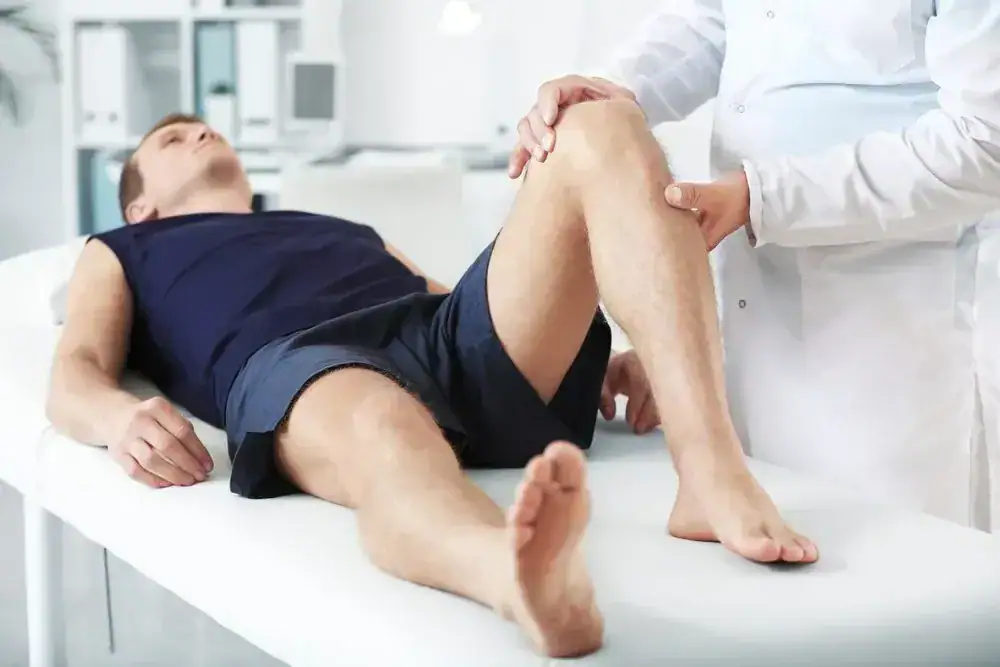
A calf stretch is one of the most underrated balance tools available to seniors. Stand facing a wall with your hands flat against it, step one foot back, and press the heel firmly into the floor. Hold for twenty to thirty seconds, then switch. Tight calves limit ankle dorsiflexion — the ability to flex your foot upward — which directly affects your ability to catch yourself when you start to tip forward.
Hip flexor stretches matter for a similar reason. Seniors who sit for long periods develop shortened hip flexors, which tilt the pelvis forward and shift the body’s center of gravity. That shift makes upright balance harder to maintain. A simple standing hip flexor stretch — one foot forward, one foot back, gently pressing the hips forward — can begin to address this over time.
Gentle spinal rotation, done seated in a chair, helps maintain the trunk mobility that allows you to turn and look without losing your footing. Sit tall, place your right hand on your left knee, and rotate slowly to the left. Hold for a few seconds, then rotate to the right. This keeps the thoracic spine mobile and supports the kind of reactive movement your body needs when balance is challenged.
None of these stretches require getting down on the floor. None of them require equipment. And none of them should cause pain — if something hurts, that’s a signal to stop and get it evaluated, not to push through. Discomfort from effort is normal. Sharp or persistent pain is not.
There’s a meaningful difference between doing balance exercises on your own and having a licensed physical therapist design and supervise a program for you. Both have value. But they’re not the same thing, and it’s worth being honest about that.
If you’ve had a fall in the past year, if you feel unsteady on stairs or uneven surfaces, if you’ve started avoiding certain activities because you don’t trust your balance — those are signs that a professional assessment would serve you better than a self-directed routine. Not because the exercises here aren’t useful, but because a therapist can identify what’s specifically driving your instability and address it directly.
One of the programs we offer at Medcare Therapy Services is the OTAGO Exercise Program — an evidence-based fall prevention protocol developed at the University of Otago and designed specifically for delivery in the home by licensed physical therapists. In randomized controlled trials, the OTAGO program has been shown to reduce falls by 35% among high-risk older adults. That’s not a generic exercise sheet. It’s a structured, progressive program that adapts as you improve.
For seniors across Long Island — particularly those in Suffolk County and Nassau County who face real transportation barriers — our in-home model matters. Falls happen at home, on familiar rugs and bathroom thresholds and back porch steps. Training in that same environment, with a therapist who can see exactly what you’re working with, produces results that translate directly to your daily life. You’re not practicing balance in a clinic and then hoping it carries over. You’re building it where it counts.
Many patients are also surprised to learn that physical therapy for balance and fall prevention is covered under Medicare Part B. And in New York State, you don’t need a doctor’s referral to get started — you can be seen by a physical therapist directly for the first 30 days or 10 visits without a prescription. The barrier to getting help is lower than most people assume.
You don’t need to overhaul your routine. You need five minutes, a sturdy chair, and a willingness to start before you feel ready. The exercises in this post are a genuine entry point — not a placeholder until you find something better. Done consistently, they work.
That said, if you want a program built around your specific situation — your strength, your history, your home environment — that’s where professional guidance makes a real difference. The goal isn’t to keep you dependent on a therapist. The goal is to build enough strength, confidence, and body awareness that you can move through your life without fear.
If you’re ready to take that next step, we work with seniors across Long Island in the clinic and in the home. Reach out at 631-866-6507 to learn more about what a personalized balance program could look like for you.
Summary:
Article details:
Share: