If you've been in a car accident on Long Island and you're worried about the cost of physical therapy, this is the page that clears it up.
If you’ve been in a car accident and you’re putting off physical therapy because you’re not sure what it’s going to cost you, you’re not alone. That hesitation is one of the most common things we hear from patients across Long Island — and it’s almost always based on a misunderstanding of how No-Fault coverage actually works. The short answer is this: if you were in a car accident in New York and you file the right paperwork within 30 days, physical therapy is covered. No copays. No deductibles. No bill waiting for you at the end. Here’s the full picture.
Every registered vehicle in New York is required by law to carry a minimum of $50,000 in Personal Injury Protection — commonly called PIP or No-Fault coverage. This isn’t optional, and it applies to every accident regardless of who caused it. That’s why it’s called No-Fault: your own insurance pays for your medical care first, no matter what happened.
That $50,000 covers physical therapy, emergency room visits, diagnostic imaging, specialist consultations, prescription medications, and even 80% of lost wages up to $2,000 per month. For most patients recovering from a soft tissue injury after a car accident, a full course of physical therapy — typically six to eight weeks — uses a fraction of that limit. The coverage is there. The question is whether you access it correctly.

This is where a lot of people get confused, and it’s worth being direct about it: No-Fault pays first. It is the primary payer for accident-related medical expenses. Your health insurance doesn’t even enter the picture until your No-Fault benefits are exhausted. That means no coordination-of-benefits headaches, no dual billing, and — critically — no copays while your No-Fault coverage is active.
To put that in concrete terms: if you normally pay a $40 copay every time you see a specialist, that doesn’t apply here. Your No-Fault insurer is billed directly by the provider, and you receive treatment without paying anything at the point of service.
There’s also an important protection most patients don’t know about. When a physical therapy provider accepts a No-Fault assignment of benefits — which we do — we take on the billing relationship with the insurer. If the insurance company later disputes a claim through what’s called an Independent Medical Examination (IME), we handle that dispute. You cannot be billed directly for a covered service that was denied through an IME. That’s a patient protection built into New York’s No-Fault regulations, and it’s one fewer thing you need to worry about.
For patients with more severe injuries who are concerned the $50,000 limit might not be enough, it’s worth knowing that optional coverage — called OBEL (Optional Basic Economic Loss) and APIP (Additional Personal Injury Protection) — can extend that limit. Whether you have this coverage depends on the policy you purchased, but it’s worth checking with your insurer if you’re facing a longer recovery.
This is a question that doesn’t get asked enough — probably because most PT practices only offer clinic-based care, so it doesn’t occur to patients that there’s another option. But for a lot of accident victims, especially in the first few weeks after a collision, driving to a clinic three times a week is genuinely painful or just not possible. Whiplash, soft tissue damage, and limited range of motion don’t exactly make navigating the LIE or Sunrise Highway during rush hour a comfortable experience.
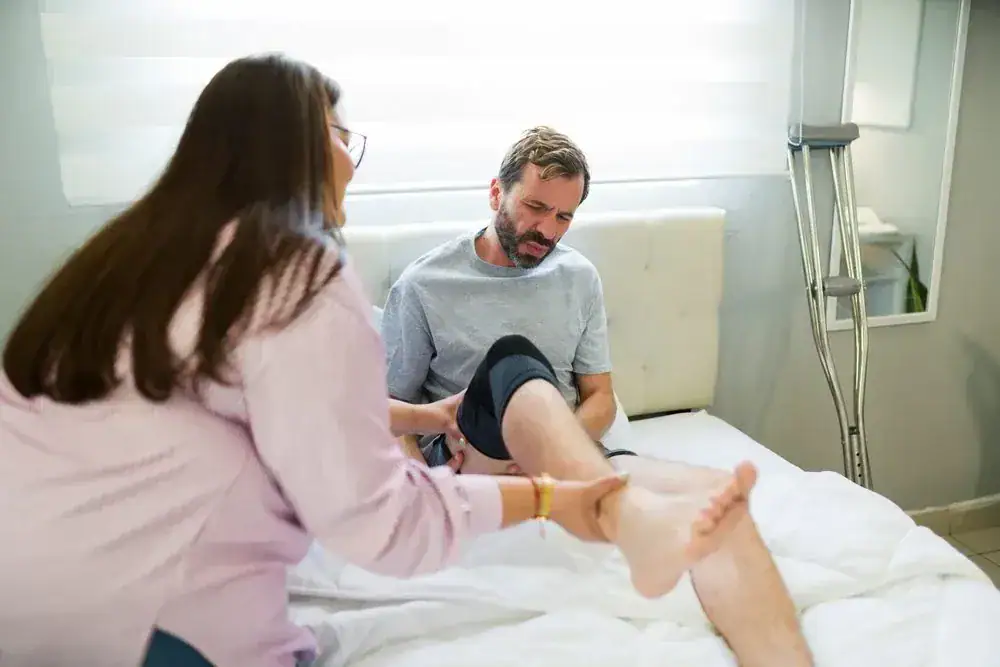
We offer in-home physical therapy that is covered under No-Fault — meaning a licensed therapist comes to you, and your insurance handles the billing the same way it would for a clinic visit. You don’t have to wait until you’re mobile enough to get yourself to an appointment. Care can start at your front door.
This matters more than it might sound. Early treatment isn’t just better for your recovery — it’s better for your claim. Insurance companies can and do use delayed treatment as a reason to question whether an injury was related to the accident. Starting care promptly, whether at home or in one of our clinic locations in Smithtown or Speonk, protects both your health and your coverage.
For patients who start with in-home care and want to transition to a clinic setting as they recover, that continuity is available through us as well. It’s one provider, two delivery options, and no gap in your treatment plan.
Want live answers?
Connect with a Medcare Therapy Services expert for fast, friendly support.
The process sounds more complicated than it is. The most important thing to understand is that there’s a hard deadline: you have 30 days from the date of the accident to file Form NF-2, the No-Fault Benefits Application, with your auto insurance company. Missing that window gives the insurer legal grounds to deny all coverage. Everything else can be sorted out — but the 30-day clock doesn’t stop.
Once the application is filed and a claim number is issued, the path to physical therapy is straightforward. You’ll need a prescription or referral from a physician — No-Fault is one of the specific situations where New York’s Direct Access rules don’t apply, so a doctor’s order is required before PT can begin. After that, you contact a No-Fault-accepting provider, and your treatment starts.

Any licensed physician can write the prescription that authorizes physical therapy under No-Fault — your primary care doctor, an urgent care physician, or an emergency room doctor you saw immediately after the accident. If you went to the ER after your accident, there may already be documentation in place. If you haven’t seen a doctor yet, that’s the first step, and it’s worth doing quickly for two reasons: the prescription unlocks PT, and it creates a medical record that documents your injury close to the date of the accident.
When you see the doctor, be clear and specific about your symptoms. Pain that feels minor in the first 48 hours can worsen significantly as inflammation sets in — particularly with whiplash and soft tissue injuries to the neck, back, and shoulders, which are among the most common outcomes of rear-end collisions. Don’t minimize what you’re feeling. The doctor’s notes from that visit become part of the medical record that supports your No-Fault claim.
Once you have the prescription, the next call is to a physical therapy provider who accepts No-Fault assignment. That’s a specific thing to confirm — not every PT practice does. When we accept a No-Fault assignment, we handle all billing directly with your insurer. You don’t fill out claim forms, you don’t chase reimbursements, and you don’t receive a bill for covered services. Your job is to show up and do the work of recovering.
One of the most persistent misconceptions we hear from patients across Suffolk and Nassau County is that No-Fault only applies to serious accidents — that a fender-bender on the Northern State or a low-speed rear-end on Route 347 “doesn’t count.” That’s not how it works. There is no minimum damage threshold and no minimum injury severity requirement. If you were in a motor vehicle accident in New York, you have No-Fault coverage available to you.
Another common question: what if you were a passenger? Passengers are covered under the driver’s No-Fault policy, so the fact that you weren’t behind the wheel doesn’t affect your eligibility. The one significant exception worth knowing about is motorcycles — motorcyclists are explicitly excluded from standard No-Fault coverage in New York, which surprises a lot of people.
Patients also worry about what happens if they’ve already missed the 30-day filing window. If that’s your situation, it’s worth speaking with a personal injury attorney before assuming coverage is gone — there are limited circumstances where late filing can be excused, and an attorney who handles No-Fault cases can assess your specific situation. We work alongside patients who are also working with legal counsel, and the two processes don’t have to be in conflict.
Finally, people ask whether No-Fault covers in-home physical therapy specifically, or only clinic visits. The coverage applies to reasonable and necessary physical therapy services regardless of where they’re delivered. For Long Island patients who are homebound or simply can’t manage the logistics of repeated clinic trips during early recovery, that’s meaningful. We serve patients across more than 200 communities in Suffolk and Nassau County, and in-home care under No-Fault is part of what we do.
The cost of physical therapy after a car accident in New York is, for most patients, zero — as long as the right steps happen in the right order. See a doctor quickly, file Form NF-2 within 30 days, get a prescription for PT, and choose a provider who accepts No-Fault assignment and handles the billing for you. That’s the whole process.
What tends to go wrong is delay. Every day spent waiting is a day closer to the filing deadline, and delayed treatment gives insurers more room to question medical necessity. If you’re in pain and you’ve been in an accident, the time to act is now — not after you’ve figured out every detail.
If you have questions about how No-Fault physical therapy works, whether in-home care is right for your situation, or how to get started, Medcare Therapy Services is here to help. We’ve been serving Long Island patients since 2010, and our team knows how to navigate this process so you don’t have to figure it out alone.
Summary:


Article details:
Share: