Before the first frost arrives, there's a window to build the strength and balance that will carry you safely through winter. Here's how to use it.

September on Long Island has a particular kind of urgency to it. The heat finally breaks, the days get shorter, and somewhere in the back of your mind, you start thinking about what winter is going to feel like. If you spent most of July and August indoors — avoiding the humidity, skipping the walks you usually take — you already know your body isn’t quite where it was in spring. You can feel it on the stairs. You notice it when you reach for something and have to steady yourself first. That feeling is real, and it matters. The good news is that right now, before the cold sets in, you have a window to do something about it.
Most fitness advice for seniors starts with a list of exercises. This one doesn’t. Because the exercises aren’t the hard part — knowing why you’re doing them is.
The seniors who stick with a fitness plan aren’t usually motivated by abstract health statistics. They’re motivated by something specific: being able to walk to the mailbox without gripping the railing, cooking a full meal without leaning on the counter, keeping up with a grandchild on a short walk. Those are real goals. They’re worth working toward. And they give a physical therapist something concrete to build a plan around.
When your goal is specific, your progress is measurable. That’s what keeps people going.

There’s a well-documented reason why so many older adults start an exercise program and quietly stop within a few weeks. Researchers call it kinesiophobia — the fear of movement, usually driven by pain or the expectation of pain. It’s not a lack of willpower. It’s a reasonable response to a body that has, at some point, hurt when it moved.
When someone has chronic joint pain, a history of falls, or just the general stiffness that builds up after a summer of reduced activity, the instinct is to move carefully and do less. That instinct feels protective. But over time, it becomes the problem. The less you move, the weaker the muscles that support your balance become, and the more likely a real fall becomes. It’s a cycle, and it’s hard to break on your own.
This is why generic exercise programs — YouTube videos, handouts from a doctor’s office, advice from well-meaning family members — often don’t work for seniors dealing with pain or fear. The exercises aren’t wrong, exactly. They’re just not calibrated to where you actually are. A program that starts too hard feels dangerous. One that starts too easy doesn’t build confidence. Neither one gets you to winter feeling stronger.
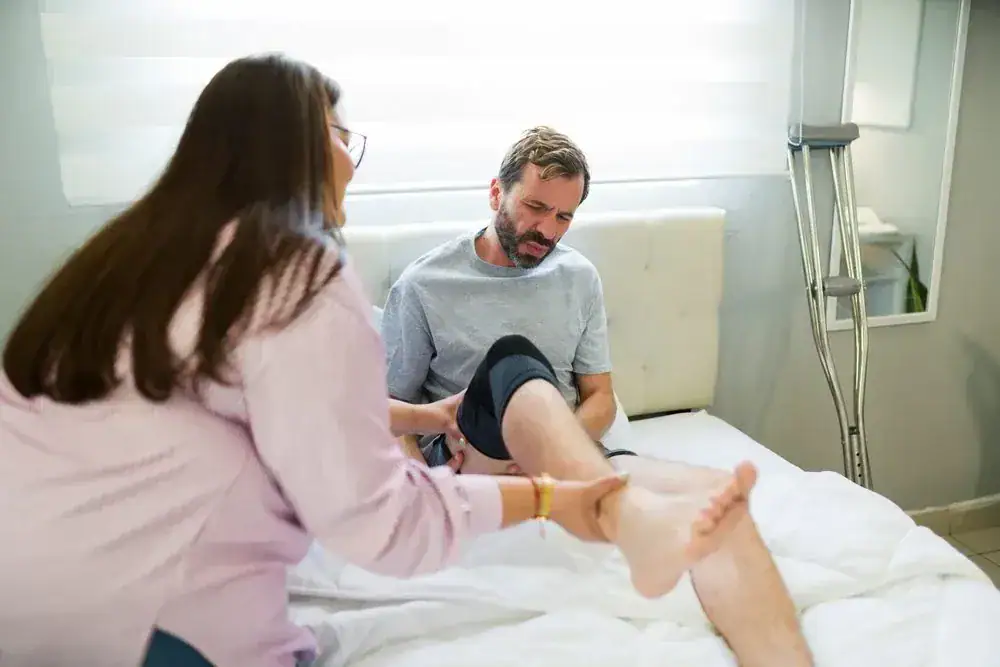
What does work is a starting point that’s been assessed by someone who has looked at how you actually move, in the environment where you actually live. A physical therapist who visits your home can see the real risks in your space — the stairs you navigate every morning, the bathroom layout, the hallways and rugs you move through daily. That assessment isn’t a luxury — it’s the difference between a plan that works and one that gets abandoned by week three.
The other thing worth knowing: the muscle loss that makes movement harder as we age is not inevitable. Research consistently shows that muscle mass can increase in older adults after regular exercise, even after significant decline. The loss is related to inactivity, not age alone. That’s an important distinction, because it means there’s something real to work toward — not just maintenance, but genuine improvement.
The CDC recommends at least 150 minutes of moderate-intensity physical activity per week for older adults. That sounds like a lot if you’ve been mostly sedentary, but it breaks down to about 20 minutes a day — and “moderate intensity” doesn’t mean running. It means moving enough to raise your heart rate slightly: a brisk walk, a set of balance exercises, a round of strength work with light resistance.
For seniors focused on fall prevention specifically, balance training is the most important component. The Otago Exercise Program — which we offer at Medcare Therapy Services — is one of the most rigorously studied fall prevention protocols available. It consists of 17 strength and balance exercises paired with a walking program, performed three times per week. Studies show it reduces falls by 35 to 40 percent in high-risk older adults. That’s a meaningful reduction. For someone who has already had a fall, or who lives alone and worries about what would happen if they did, that level of improvement is significant.
Strength work matters too, particularly for the muscles in your legs and core that respond first when your balance is challenged. The fast-twitch muscle fibers — the ones that fire quickly when you start to tip — are the first to decline with inactivity, and they’re the ones most responsible for catching yourself before a fall becomes a fall. Targeted strength exercises rebuild exactly those fibers.
What this looks like in practice varies by person. Someone recovering from a hip replacement has a different starting point than someone who has been walking regularly but wants to feel more stable on uneven ground. Someone managing arthritis needs a different approach than someone whose main challenge is low energy and general deconditioning after a sedentary summer. The goal-setting process is personal because the starting point is personal.
Want live answers?
Connect with a Medcare Therapy Services expert for fast, friendly support.
Long Island winters are not gentle. Icy driveways, frozen sidewalks, and the kind of cold that makes joints stiffen up before you’ve even gotten out of bed — these are real conditions that make movement harder and fall risk higher. For seniors across Suffolk County, where most neighborhoods require a car to get anywhere, winter also means that getting to a clinic for physical therapy can become its own obstacle.
This is the practical case for starting now, in September or October, rather than waiting until after the first freeze. The strength and balance you build before winter carries you through it. The habits you establish before the days get short are easier to maintain than ones you try to start in January.

Most fall prevention programs are delivered in clinics, gyms, or community centers. There’s nothing wrong with that, except for one thing: falls don’t happen in clinics. They happen at home — on the stairs you use every morning, in the bathroom, on the rug in the hallway you’ve walked past a thousand times without thinking about it.
When a licensed physical therapist comes to your home, they see what no clinic assessment can show them. They watch how you navigate your actual space. They notice the step you’ve learned to avoid, the chair you always use to push yourself up, the way you grip the wall when you come down the hall. That information shapes a better plan — one that addresses the real risks in the real environment, not a simulated version of it.
For seniors across Suffolk County and Nassau County, in-home therapy also removes the logistics problem entirely. No driving in bad weather. No asking a family member to rearrange their schedule. No icy parking lots between you and your appointment. We come to you, which means your program continues regardless of what’s happening outside.
We’ve worked with patients across more than 200 Long Island communities — from Smithtown to Holbrook to the East End near Speonk — and the in-home model consistently makes the difference for patients who would otherwise delay or skip care during winter months. For seniors on the East End in particular, where healthcare options are more limited and distances are longer, having a therapist come to the house isn’t just convenient. It’s often the only realistic option.
Every patient we see at home works with the same therapist each visit. That continuity matters more than most people expect. It means your therapist knows your history, tracks your progress week to week, and adjusts your plan as you improve — rather than starting from scratch each time because you’ve seen someone different.
One of the most common reasons seniors delay physical therapy is the assumption that it will be expensive or that insurance won’t cover it. That assumption is wrong more often than people realize.
Medicare covers physical therapy when it’s medically necessary — and for most older adults managing fall risk, balance issues, post-surgical recovery, or chronic pain, it qualifies. We accept Medicare and most commercial insurance plans, and we verify your coverage before your first visit so there are no surprises. You know what’s covered before you commit to anything.
Beyond standard physical therapy, there are specific senior wellness programs worth knowing about. SilverSneakers is a fitness benefit included with many Medicare Advantage plans — it provides access to fitness programming designed specifically for older adults at no additional cost to eligible members. Many seniors don’t realize they already have this benefit and have never used it.
The Otago Exercise Program, which we touched on earlier, is another example of evidence-based care that goes beyond generic advice. It was developed by fall prevention researchers, validated by the National Council on Aging, and studied extensively in clinical trials. When we recommend it, there’s a body of published research behind that recommendation.
We also offer Senior Personal Training and dedicated Fall Prevention programming for patients whose goals extend beyond recovery into ongoing fitness and strength maintenance. These aren’t one-size-fits-all programs. They’re built around what you’re trying to accomplish, adjusted as you progress, and delivered by therapists who hold a Doctor of Physical Therapy degree with advanced certifications.
If you’ve ever left a doctor’s appointment with instructions to “stay active” and no idea what that actually means for you specifically, this is what the follow-through looks like. A plan, a therapist who knows you, and a program designed to get you to a specific goal — not just movement for movement’s sake.
The window between summer and winter is short, and it’s the best opportunity most seniors have to build real momentum before cold weather makes everything harder. The strength you build now is the strength that catches you in February. The balance work you start in September is what lets you walk to the car in January without thinking twice about it.
You don’t need a dramatic plan. You need a realistic one — built around what you actually want to be able to do, starting from where you actually are, in the environment where you actually live.
If you’re a Long Island senior thinking about what this fall and winter should look like for your health, or if you’re a family member trying to help a parent stay safe and independent at home, Medcare Therapy Services is a good place to start that conversation. Give us a call at 631-866-6507 and we’ll talk through what makes sense for your situation.
Summary:

Article details:
Share: