Medicare covers more physical therapy than most people realize — but the rules differ depending on your plan. Here's what you actually need to know.

Most people who need physical therapy don’t skip it because they don’t want help. They skip it because they’re not sure what Medicare will actually pay — and nobody wants to start treatment and end up with a bill they weren’t expecting. That hesitation is understandable, but it’s also costing a lot of seniors the recovery they deserve. Medicare covers physical therapy more broadly than most people realize, and the rules have changed significantly in recent years. This guide walks you through exactly what’s covered, what you’ll actually owe, and when in-home physical therapy is an option — so you can make a confident decision, not a guesswork one.
Yes — Medicare covers physical therapy, and in most cases it covers it well. The part that trips people up is understanding which portion of Medicare applies to their situation, because Parts A, B, and Advantage each work a little differently.
For most outpatient physical therapy — including specialized services such as gait training, meaning you go to a clinic or a therapist comes to your home — Medicare Part B is the relevant coverage. Part A applies when you’re receiving PT as part of an inpatient hospital stay or a stay in a skilled nursing facility. If you’re enrolled in a Medicare Advantage plan through a private insurer, those plans are required by law to cover at least as much as Original Medicare, and many cover more.
The most important thing to understand is that there is no hard annual cap on how many PT sessions Medicare will cover. That cap was eliminated in 2018. What exists now is a monitoring threshold — around $2,410 in 2025 — that, once crossed, simply requires your provider to document that the therapy is medically necessary. Coverage continues as long as the need is real.

This is one of the most common questions we hear, and the answer is nuanced. You don’t need a formal referral from your doctor to start physical therapy under Medicare Part B — but your provider does need to be Medicare-enrolled, and Medicare requires that a physician certify the medical necessity of your treatment. In practical terms, that means your doctor needs to be in the loop, even if they’re not the one initiating the process.
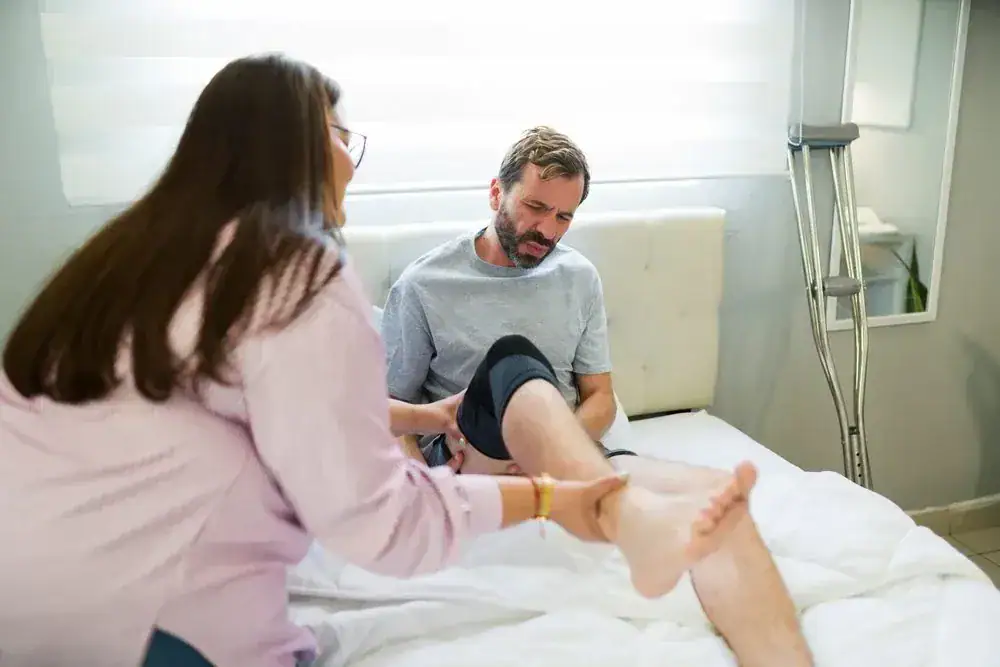
For in-home physical therapy — which is covered under Medicare’s home health benefit — the requirement is a bit more specific. A physician must certify that you are homebound, meaning that leaving your home requires considerable effort or assistance. This doesn’t mean you can never leave the house; it means that doing so is genuinely difficult due to your condition, mobility limitations, or health status. Once that certification is in place, a licensed physical therapist can come directly to your home, and those services are fully covered under Medicare.
What this looks like in practice: a senior recovering from hip replacement surgery, someone with significant balance issues who is at high fall risk, or a patient managing a neurological condition like Parkinson’s disease — these are exactly the situations where in-home PT under Medicare’s home health benefit applies. The physician documents the homebound status, a plan of care is established, and therapy begins at home.
Under Part B for outpatient PT, after you meet the annual Part B deductible — which is $240 in 2024 — Medicare covers 80% of the approved cost for each session. You’re responsible for the remaining 20% coinsurance. If you have a Medicare supplement (Medigap) plan, that 20% may be covered entirely. If you’re on a Medicare Advantage plan, your cost-sharing structure will depend on your specific plan, but the coverage floor is the same as Original Medicare.
One misconception worth clearing up: some people believe Medicare only covers PT in a hospital or nursing home setting. That’s not accurate. Medicare Part B covers outpatient physical therapy in clinics, private practices, and — under the home health benefit — in your own home. The setting doesn’t determine coverage; the medical necessity and provider enrollment do.
Medicare Advantage plans — sometimes called Part C — are private insurance plans that replace Original Medicare while delivering the same core benefits. By law, every Advantage plan must cover at least what Parts A and B cover, including physical therapy. Many plans go further, offering lower copays for PT visits, broader in-home care services, or additional wellness programs.
If you’re on a Medicare Advantage plan, the specific cost-sharing structure — your copay per PT visit, your out-of-pocket maximum — will vary by plan. The key question to ask your plan is whether a specific provider is in-network, because out-of-network PT may cost more or require prior authorization.
We accept Medicare and work with patients to verify coverage before treatment begins. That means no guessing, no surprises at the billing stage, and no situation where you start care and discover partway through that something wasn’t covered the way you expected. We handle the documentation requirements — including the KX modifier that Medicare requires when therapy costs exceed the annual threshold — so you don’t have to navigate that on your own.
For families managing a parent’s care, this matters more than almost anything else. The last thing you need is a billing dispute on top of everything else you’re coordinating. Knowing that your provider is handling the Medicare side correctly gives you one less thing to worry about.
Want live answers?
Connect with a Medcare Therapy Services expert for fast, friendly support.
For many seniors, getting to a physical therapy clinic isn’t just inconvenient — it’s genuinely not possible. Limited public transit and seniors who no longer drive depend on family members or medical transport to get anywhere. When that transportation isn’t available, or when a health condition makes travel difficult, in-home physical therapy becomes not just a preference but a necessity.
Medicare’s home health benefit exists precisely for this situation. When a physician certifies that a patient is homebound, Medicare covers in-home physical therapy visits in full — no copay, no coinsurance, no deductible for the home health benefit itself. A licensed therapist comes to the patient’s home, assesses the environment, and delivers treatment in the space where the patient actually lives and moves.

What makes in-home physical therapy particularly valuable is the housing environment. Most homes built in the 1950s through the 1970s have stairs, narrow hallways, uneven outdoor surfaces, and decades-old bathroom layouts that create real fall hazards. A clinic visit simply cannot address these obstacles.
When a therapist works with a patient in their actual home, they can see the environment, identify the specific risks, and tailor the treatment to the real obstacles that patient faces every day. This is a meaningful clinical difference, not just a convenience. A senior who practices balance exercises in a clinic is working in a controlled environment. A senior who practices those same movements in their own kitchen, near their own furniture, on their own floors, is building the functional strength and confidence that actually prevents falls at home.
We serve communities with in-home coverage, bringing licensed physical therapy directly to patients’ doors. Home care services under the Medicare home health benefit also include occupational therapy, which focuses on the activities of daily living — getting dressed, bathing, preparing meals, managing medications. For seniors dealing with multiple challenges at once, having both physical and occupational therapy available through a single health care agency simplifies the coordination significantly.
The homebound requirement is worth understanding clearly, because it’s stricter than some people expect. Medicare defines homebound as a condition where leaving home requires a considerable and taxing effort, or where a medical condition makes leaving inadvisable. It doesn’t mean a patient is completely bedridden or never leaves the house — but it does mean that community outings are infrequent and require real assistance. If you’re unsure whether a patient qualifies, the physician’s assessment is the determining factor, and we can help you have that conversation.
Balance problems are one of the most common reasons seniors end up needing physical therapy — and one of the most commonly dismissed. It’s easy to chalk up unsteadiness to “just getting older.” But balance is a trainable skill, not an inevitable decline, and physical therapy can produce measurable improvements even in patients who have been struggling with stability for years.
The statistics behind falls in the elderly are worth taking seriously. More than one in four adults over 65 falls each year. Falling once doubles the risk of falling again. Falls are the leading cause of injury death for adults 65 and older, and fall-related deaths have increased by 51% over the past decade.
What physical therapy does is address the root causes of fall risk: muscle weakness, impaired gait, reduced coordination, and poor balance reactions. A therapist doesn’t just hand you a sheet of exercises. They assess where your specific vulnerabilities are, build a progressive program around them, and track your improvement over time.
We offer the OTAGO Exercise Program — an evidence-based, PT-delivered series of 17 strength and balance exercises that has been shown to reduce falls between 35% and 40% in frail older adults. It’s delivered over six months to a year, in the patient’s home, by a licensed physical therapist who adjusts the program as the patient progresses. It’s not a group class or a general fitness routine. It’s a structured clinical intervention with documented outcomes.
We also offer senior personal training programs for patients who are less acutely impaired but want to build strength and stability proactively. The right program depends on where a patient is starting from — which is why every plan of care begins with a thorough assessment, not a one-size-fits-all protocol.
Medicare covers physical therapy — the billing confusion is real, but it shouldn’t be the reason someone delays care. The therapy threshold replaced the old cap in 2018, the Part B deductible is $240, and after that Medicare covers 80% of approved costs. For homebound patients, in-home PT is covered in full. For everyone else, outpatient PT at a clinic is covered the same way.
If you’re trying to figure out whether your situation qualifies — or whether a parent’s does — the fastest answer is a phone call. We accept Medicare, verify coverage before treatment begins, and handle the documentation so the billing process doesn’t fall on you.
Call us at 631-866-6507. We’ll help you figure out what’s covered, what to expect, and what the right next step looks like.
Summary:

Article details:
Share: