
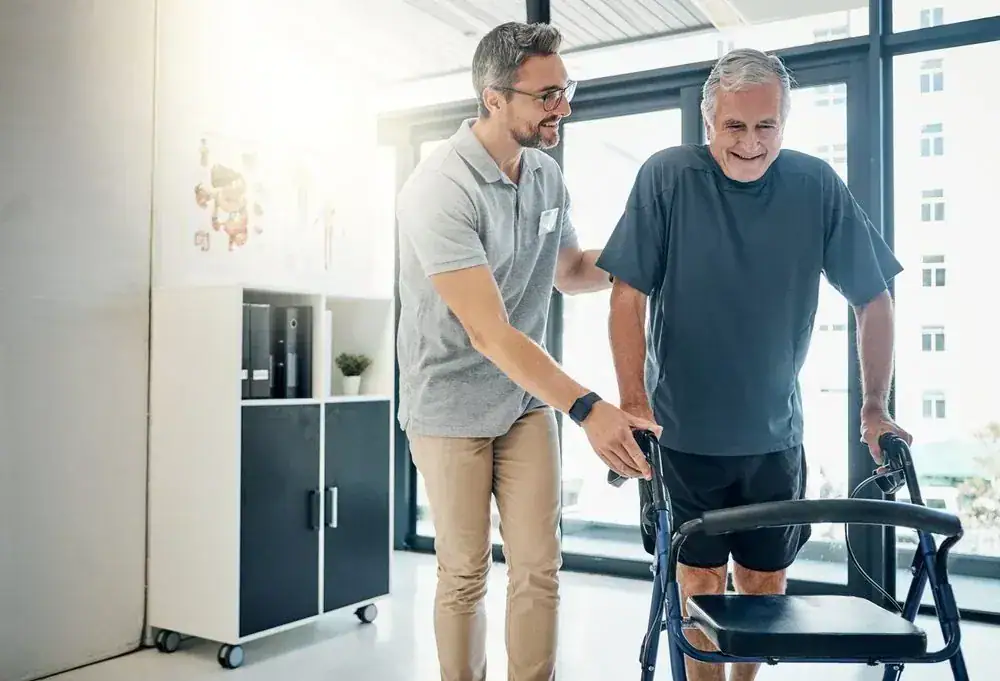

You’re not looking for a gym membership or a lecture about being careful. You want to feel steady on your feet again—in your kitchen, your bathroom, your driveway. You want to stop second-guessing every step.
That’s what fall prevention therapy does. It rebuilds the strength in your legs, retrains your balance, and gives you back the confidence to move without fear. Research shows that when you start physical therapy within three months of noticing balance issues, you can lower your fall risk by 86%. Not a little safer—significantly safer.
And here’s what matters for Long Island residents: Nassau and Suffolk counties rank 4th and 5th in New York State for fall-related incidents. You’re statistically more at risk here than almost anywhere else in the state. That’s not meant to scare you—it’s meant to show you why targeted balance exercises for seniors actually matter. The right program, done consistently, can cut your fall risk by up to 50%. That’s the difference between a close call and a hospital stay.
We’ve been providing home-based physical therapy across Long Island for over 14 years. We work with seniors in Patchogue, East Patchogue, Bellport, Medford, and throughout Suffolk County who need therapy but can’t easily get to a clinic.
We accept Medicare and nearly all commercial insurance. Every therapist is licensed, and every treatment plan is built around what you can actually do—not some one-size-fits-all protocol. You’re not a number here. We treat you like family because that’s how we’d want our own parents treated.
If getting to appointments is hard, we come to you. If you’re worried about cost, we’ll walk you through your coverage. If you’ve fallen before and you’re afraid it’ll happen again, we’ll show you exactly how we’re going to change that.

First, we evaluate where you are right now. Your therapist will assess your strength, balance, gait, and any areas where you feel unsteady. This isn’t a pass-fail test—it’s a baseline so we know what to work on.
Then we build your program. Most fall prevention plans combine strength training and balance exercises because that combination is what works. You’ll do things like sit-to-stand exercises to build leg strength, weight shifts to improve stability, and controlled movements that retrain your body to catch itself. The goal for each exercise is to hold the position for 10 seconds, then progress to 30 seconds. You’ll do five reps, twice a day.
We don’t just hand you a sheet of exercises and disappear. Your therapist comes to your home, walks you through each movement, watches your form, and adjusts as you improve. Over time, you’ll notice you’re steadier. You’ll stop grabbing the counter every time you stand up. You’ll walk to the mailbox without thinking about it.
That’s the point. We’re not trying to turn you into an athlete—we’re helping you live your life without fear.

Ready to get started?
Every program starts with a full fall risk assessment. We look at your medical history, medications, vision, home environment, and physical abilities. Then we design a plan that fits your life.
Your therapy includes balance training, lower extremity strengthening, gait training, and functional mobility work. That means we’re not just doing exercises for the sake of it—we’re training you to do the things you actually need to do. Getting in and out of the shower. Walking on uneven pavement. Reaching for something on a high shelf without losing your balance.
For Long Island seniors, home safety is a big part of the conversation. We’ll talk about fall hazards in your house—loose rugs, poor lighting, clutter in walkways. Small changes make a big difference, and we’ll help you spot them.
You’ll also get a personalized home exercise program based on your evaluation. These aren’t generic stretches—they’re movements your therapist prescribes because they target your specific weak spots. And because we accept Medicare and most insurance plans, cost doesn’t have to be a barrier. We’ll verify your coverage and explain what’s included before we start.

If you start therapy within three months of noticing balance problems or being assessed for fall risk, research shows you can reduce your fall risk by up to 86%. That’s a significant drop, and it happens because you’re addressing the root causes—weak legs, poor balance, slow reaction time—before they lead to an actual fall.
Most people start feeling steadier within the first few weeks. You might notice you’re not grabbing onto furniture as much, or that you feel more confident walking outside. Real improvement takes consistency, though. If you do your exercises twice a day like your therapist recommends, you’ll see measurable changes in strength and balance within 4 to 6 weeks.
The key is starting now, not after a fall. Once you’ve fallen, recovery is harder and the fear is worse. Therapy works best as prevention, not damage control.
Your program will likely include sit-to-stand exercises, which build the leg strength you need to get up from a chair or toilet without using your hands. You’ll also do weight shifts—moving your weight from one foot to the other while standing—to improve your stability and reaction time.
Other common exercises include standing on one leg (with support nearby), heel-to-toe walking, and controlled stepping patterns. These retrain your body to stay balanced when your center of gravity shifts, which is exactly what happens when you trip or stumble.
Your therapist will start where you are. If you need to hold onto a counter at first, that’s fine. The goal is to progress gradually—from 10-second holds to 30-second holds, from using support to letting go. Every exercise is designed to mimic real-life movements so you’re not just getting stronger in a vacuum—you’re getting stronger in ways that actually matter.
Yes. Medicare Part B covers physical therapy for fall prevention when it’s medically necessary and prescribed by your doctor. That means if you’ve had a fall, you’re at risk of falling, or you have a condition that affects your balance, therapy is typically covered.
We accept Medicare and nearly all commercial insurance plans. Before we start, we’ll verify your coverage and let you know what your out-of-pocket costs will be, if any. Most people are surprised to learn that home-based therapy is covered the same way clinic-based therapy is—but without the hassle of transportation.
If you’re not sure whether you qualify, call us. We’ll walk you through it and help you get any referrals or documentation you need. The last thing you should be worrying about is paperwork when you’re trying to stay safe.
Nassau and Suffolk counties rank 4th and 5th in New York State for fall-related incidents among seniors. In Nassau County alone, 88% of injury hospitalizations for adults over 65 are due to falls. That’s not a small problem—it’s a public health crisis.
Part of it is demographics. Long Island has a large aging population, and many seniors live independently in single-family homes where fall hazards are common. Another factor is access to preventive care. A lot of people don’t realize they’re at risk until after they’ve already fallen, and by then the damage is done.
That’s why we focus so heavily on early intervention. If you’re over 65, have noticed any balance issues, or have fallen in the past year, you’re a candidate for fall prevention therapy. The statistics are scary, but they also prove why this work matters. You don’t have to become a statistic.
Home therapy removes the barriers that keep people from getting care. If you have trouble driving, don’t have reliable transportation, or feel unsteady walking through a parking lot, getting to a clinic becomes its own risk. We come to you, so you can focus on the therapy instead of the logistics.
There’s also a practical advantage: we see your actual environment. We can spot fall hazards in your home—loose rugs, poor lighting, furniture placement—and help you fix them. We can practice the exact movements you do every day, in the spaces where you do them. That’s harder to replicate in a clinic.
And for a lot of people, it’s just more comfortable. You’re in your own space, working one-on-one with a therapist who gets to know you and your routine. It’s personalized care without the clinical feel. That matters when you’re trying to build confidence.
Most programs run between 6 and 12 weeks, depending on your starting point and goals. If you’re recovering from a fall or dealing with significant weakness, you might need closer to 12 weeks. If you’re relatively strong but want to improve balance and prevent future falls, 6 to 8 weeks might be enough.
Your therapist will reassess you regularly to track progress and adjust your plan. Once you’ve hit your goals—stronger legs, better balance, more confidence—you’ll transition to a maintenance program you can do on your own. We’ll give you the tools to keep up the work after therapy ends.
The timeline isn’t set in stone. Some people progress faster, some need more time. What matters is that you’re moving in the right direction and that the program fits your life. We’re not rushing you out the door—we’re making sure you’re actually safer when we’re done.
Other Services we provide in Patchogue