
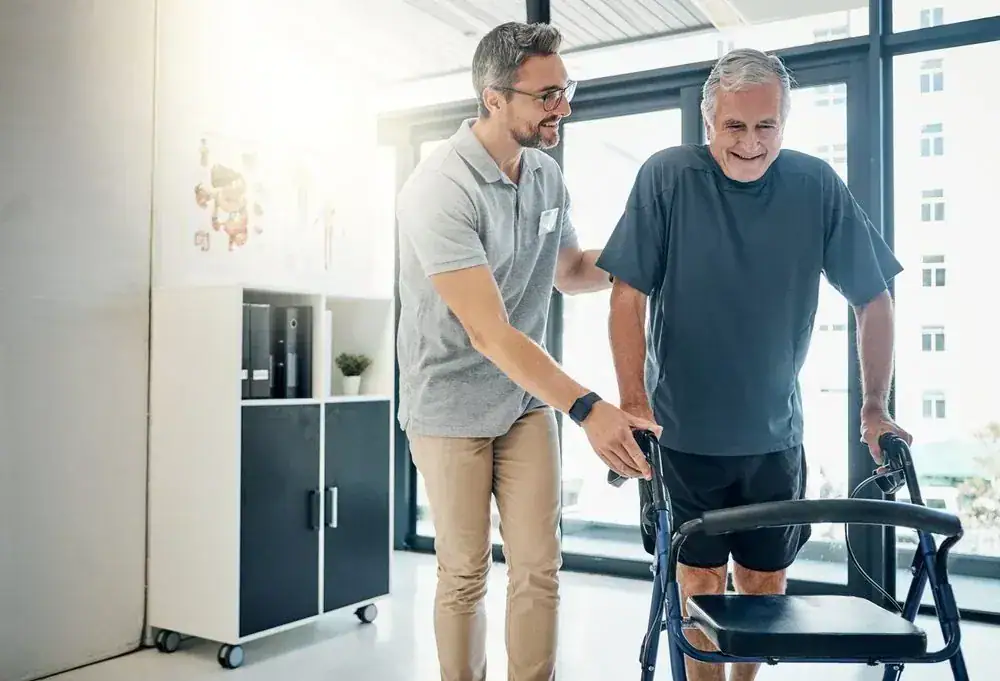
You stop hesitating before you stand up. You walk to the mailbox without gripping the railing the whole way. You move through your day without that constant background fear that one wrong step could change everything.
That’s what happens when your balance improves and your legs get stronger. Research shows targeted balance exercises for seniors can reduce your fall risk by up to 24%. But the real difference shows up in how you feel when you’re standing in your kitchen, walking through your home, or getting up in the middle of the night.
Our physical therapy for balance focuses on the movements that matter in your daily life. You’re not doing generic exercises. You’re training your body to handle the specific situations where you feel unsteady—standing up from your favorite chair, reaching into cabinets, turning around in tight spaces. The exercises simulate what you actually do every day, so the strength and stability you build translate directly to real confidence.
We’ve been helping Long Island residents stay independent for over a decade. We’re licensed professionals who specialize in home-based therapy, which means you get Medicare-covered treatment without the hassle of traveling to a clinic.
Our therapists are trained in Otago fall prevention protocols—one of the most researched and effective elderly fall prevention programs available. We’re not just running you through standard exercises. We’re assessing your specific risk factors, your home environment, and the exact situations where you feel unsteady.
Lynbrook residents face the same challenges as seniors across Nassau County—aging housing stock with stairs, uneven sidewalks, and the desire to stay in homes they’ve lived in for decades. We understand that context because we’ve been working in these communities long enough to know what matters to you.

First, we come to your home and do a complete fall risk assessment. We’re looking at your strength, your balance, how you move through your space, and what specific activities make you feel unstable. This isn’t a quick checklist—it’s a real evaluation of where you are and what needs attention.
Then we build your program. It’s based on what we found in your assessment and tailored to your goals. Maybe you want to feel safer going up and down your stairs. Maybe you want to garden again without worrying about getting back up. We design senior balance exercises that target those exact movements.
You’ll work with the same therapist throughout your program, usually two to three times per week to start. Sessions happen in your home, using your furniture, your stairs, your actual environment. As you get stronger, we progress the exercises. As your balance improves, we add complexity. The program evolves with you.
Most people start seeing changes within a few weeks—better stability, less fear, more confidence in daily activities. The goal isn’t just to reduce fall risk on paper. It’s to give you back the freedom to move through your life without constant worry.

Ready to get started?
You get a licensed physical therapist who comes to your home and works with you one-on-one. Every session is focused on your specific needs—not a group class where you’re doing the same thing as everyone else.
Your program includes strength training for your legs and core, balance training that challenges your stability in progressive ways, and gait training to improve how you walk. We also work on functional movements—the things you do every day like getting in and out of chairs, reaching for objects, and navigating your home safely.
For Lynbrook residents, this matters because many homes in the area were built decades ago. You might be dealing with narrow staircases, small bathrooms, or layouts that weren’t designed with aging in place in mind. We assess those environmental factors and teach you how to move safely in your actual space, not some generic therapy gym.
Everything is covered by Medicare if you qualify, which most people over 65 do. We handle the paperwork and verification. You just focus on getting stronger and more stable.
Most people notice changes in how they feel within two to three weeks. You might find you’re steadier when you stand up, or you’re not grabbing for support as often when you walk. Those early wins matter because they start rebuilding your confidence.
Measurable improvements in strength and balance typically show up around the four to six week mark when you’re consistent with your exercises. That’s when we’ll retest your balance and you’ll see objective progress—better scores on stability tests, improved walking speed, stronger legs.
The research backs this up. Studies show that structured balance and strength programs produce significant fall risk reduction after eight to twelve weeks of regular training. But here’s what matters more than timelines: the gains stick around as long as you keep up with the exercises, even at a maintenance level.
You could try exercises on your own, but here’s the problem: you don’t know what you don’t know. Most people who fall don’t realize what their specific risk factors are. Maybe your right leg is significantly weaker than your left. Maybe you have a vestibular issue affecting your balance. Maybe your home setup is creating unnecessary hazards.
A physical therapist identifies those specific issues through proper assessment. We’re not just handing you a generic exercise sheet. We’re diagnosing why you’re unsteady and building a program that addresses your actual problems. That’s why supervised programs show better results than self-directed exercise—the customization matters.
There’s also a safety factor. Some balance exercises can actually increase fall risk if you’re doing them wrong or progressing too quickly. We make sure you’re challenged enough to improve but not so much that you’re at risk. Once you’ve built a foundation and know what you’re doing, you can absolutely continue many exercises independently.
Yes, if you meet Medicare’s criteria for home health services. Generally, that means you have difficulty leaving your home due to mobility issues, medical conditions, or safety concerns. If getting to a clinic is genuinely difficult for you—which it is for many people worried about falling—you likely qualify.
Medicare Part B covers outpatient physical therapy, including home-based services, when it’s deemed medically necessary. Your doctor needs to order the therapy, and we need to document that you’re homebound. But we handle all of that coordination. You’re not filling out complicated forms or fighting with insurance companies.
There are coverage limits—Medicare covers up to a certain dollar amount per year for therapy services, though exceptions exist for medically necessary care. We track your benefits and let you know where you stand. Most people going through a fall prevention program stay well within their coverage limits, especially since preventing a fall is far less costly than treating injuries from one.
Regular physical therapy often focuses on recovering from an injury or surgery. Fall prevention is proactive—you’re training to prevent something from happening, not rehabilitating after it already did. That requires a different approach.
We use specialized protocols like the Otago Exercise Program, which has been extensively researched specifically for fall prevention in older adults. It’s not generic strengthening. It’s a targeted combination of balance retraining, strength building, and walking practice that’s been proven to reduce falls by up to 35% in community-dwelling seniors.
The other major difference is environmental. We’re in your home, working with your actual living space. We see the throw rug that slides, the lighting that’s too dim, the step up into your bathroom. We address those real-world factors alongside your physical training. You’re not learning to balance on equipment in a clinic that doesn’t exist in your daily life—you’re training in the exact environment where you need to be stable.
It’s not too late—it’s actually the most important time to start. Once you’ve fallen, your risk of falling again increases significantly. About half of people who fall once will fall again within a year if nothing changes. But that statistic also means half won’t, and the difference usually comes down to whether they addressed the underlying issues.
After a fall, your body might have compensated in ways that actually increase your risk. Maybe you’re moving more cautiously, which sounds good but can actually make you more unstable. Maybe you lost confidence and became less active, which leads to further strength loss. Maybe the original cause—weak legs, poor balance, medication side effects—never got addressed.
We start by figuring out why you fell in the first place. Was it pure accident, or were there contributing factors you can control? Then we rebuild your strength and stability systematically. Many people who’ve fallen become our most motivated clients because they know exactly what they’re trying to avoid. That motivation, combined with the right program, makes a real difference.
The intensive phase of your program typically runs eight to twelve weeks. That’s how long it takes to build meaningful strength and balance improvements when you’re working with a therapist two to three times per week. After that, you transition to maintenance.
Maintenance means continuing exercises on your own, usually three to four times per week, to preserve the gains you’ve made. Your body doesn’t stay strong and balanced automatically—you have to keep challenging it. But the good news is that maintenance requires less time and intensity than the initial building phase.
Some people choose to continue with periodic therapy sessions—maybe once a month or once a quarter—as a check-in to make sure their form is still good and they’re progressing appropriately. Others feel confident continuing independently once they’ve learned the exercises and understand the principles. The key is consistency. The benefits of balance and strength training last as long as you keep doing the work, even at a reduced level.
Other Services we provide in Lynbrook