
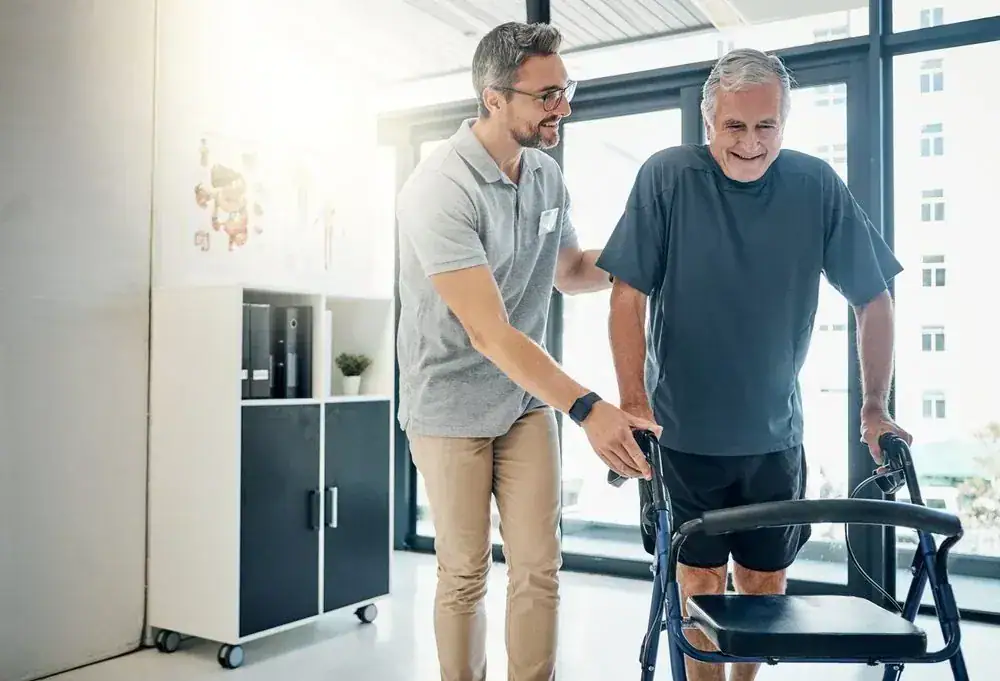
You’re not imagining it. Your balance isn’t what it used to be. Maybe you’ve already had a close call – or worse, an actual fall. Now you’re second-guessing every step, avoiding stairs, holding onto walls even when you don’t need to.
That fear? It actually increases your fall risk. The less you move, the weaker you get. The weaker you get, the more likely you are to fall. It’s a cycle that steals your independence one careful step at a time.
Balance exercises for seniors break that cycle. Targeted physical therapy retrains your brain-body connection, strengthens the muscles that keep you upright, and activates your core. You’ll notice the difference when you walk to the mailbox, get out of the shower, or navigate your kitchen. Small improvements that mean everything when you’re trying to stay in your own home.
Research backs this up. Seniors who do regular balance and strength training see their fall risk drop by 28%. That’s not a small number when you consider that one out of four older adults falls each year – and 95% of hip fractures come from falls.
We’ve been providing home-based physical therapy across Lake Ronkonkoma and Long Island for over a decade. We’re not new to this. Our therapists specialize in fall prevention programs designed by Otago specialists – an evidence-based approach that’s proven to reduce falls in older adults.
Here’s what matters to you: we come to your home. No driving to appointments. No waiting rooms. No trying to navigate an unfamiliar clinic when your balance is already shaky. We assess your specific fall risks where they actually happen – in your kitchen, your bathroom, your bedroom.
Lake Ronkonkoma sees the same statistics as the rest of New York. Around 30,500 emergency department visits each year among older adults are fall-related. Many of those falls happen at home. We treat you like family because we understand what’s at stake. You want to stay independent. We want that for you too.

First, we assess. A therapist comes to your home and evaluates your balance, strength, gait, and fall risk factors. We look at how you move through your actual living space – not a generic clinic setting. We identify what’s putting you at risk, whether that’s weak legs, poor coordination, unsafe rugs, or medication side effects.
Then we build your program. It’s custom. Some people need more strength work. Others need gait training or core activation. We design senior balance exercises that match your current ability and push you just enough to see progress. You’re not doing some one-size-fits-all routine from a handout.
You do the work – with us there. Sessions happen in your home, usually within 24 hours of your first call. We guide you through each exercise, correct your form, and adjust as you improve. Over time, you’ll notice your walking speed increases. Your confidence comes back. That fear of falling starts to fade because your body is actually stronger and more stable.
Most programs are covered by Medicare when delivered by licensed professionals. You’re not paying out of pocket for something that should be accessible.

Ready to get started?
Balance training that’s specific to your needs. We don’t hand you a sheet of exercises and leave. You get supervised sessions with a licensed physical therapist who knows how to reduce fall risk in older adults. That includes functional exercises, resistance training, and coordination drills that translate to real-world movement.
Gait training if you need it. Many falls happen because your walking pattern has changed over time – maybe you’re shuffling, or your stride is shorter, or you’re favoring one side. We retrain your gait cycle so you walk more efficiently and safely.
Home safety evaluation. Sixty percent of fall-related hospitalizations among older adults happen at home. We look at your environment and point out risks you might not notice – loose rugs, poor lighting, clutter in walkways, grab bars that should be installed. Small changes that make a big difference.
Strength and mobility work. You can’t balance well if your legs are weak. We focus on the muscle groups that keep you upright and help you recover if you start to stumble. Stronger legs mean better stability. Better stability means fewer falls.
This isn’t a six-week program that ends and leaves you on your own. You’ll have a plan you can continue after formal therapy ends. The goal is long-term independence, not short-term improvement.
Most people notice small changes within two to three weeks. You might find you’re steadier getting out of a chair or walking across a room. Meaningful improvement – the kind that actually reduces your fall risk – usually takes six to eight weeks of consistent work.
That timeline depends on where you’re starting from. If you’ve been inactive for a while or you’ve already fallen, it may take longer. If you’re catching balance issues early, you’ll progress faster. The key is consistency. Doing your exercises twice a week won’t cut it. You need regular sessions plus daily practice of what we teach you.
Research shows that balance training programs result in reduced fear of falling, increased walking speed, and improved physical function. But those outcomes don’t happen overnight. Your body needs time to rebuild strength and retrain the neurological pathways that control balance. Stick with it, and the results are measurable.
Yes, when it’s provided by licensed professionals like our therapists. Medicare covers outpatient physical therapy for fall prevention if it’s medically necessary and prescribed by a doctor. Most people qualify without any issues.
You don’t always need a physician’s prescription to start. We can often begin an evaluation and get the necessary paperwork handled quickly – usually within 24 hours. If you’ve already fallen, or if your doctor has noted balance issues or fall risk in your chart, approval is straightforward.
What Medicare doesn’t cover is maintenance therapy – sessions that aren’t actively improving your condition. But during the active treatment phase, when you’re building strength and retraining balance, coverage applies. If you have a Medicare Advantage plan, the specifics might vary slightly, but fall prevention is generally covered across the board because it’s proven to reduce more costly outcomes like hip fractures and hospitalizations.
It’s not too late. In fact, you’re in the highest-risk group, which makes starting therapy even more important. Falling once doubles your chances of falling again. That’s not meant to scare you – it’s just the reality. Your body has already shown it can’t catch itself the way it used to.
The good news is that physical therapy decreases fall incidents by up to 37% in seniors, even those who’ve already experienced a fall. We’ve worked with people recovering from hip fractures, wrist breaks, and head injuries. Once you’re medically cleared, we can start rebuilding the strength and coordination you lost – and address whatever caused the fall in the first place.
Many people don’t tell their doctor after a fall because they’re afraid of losing independence or being forced into assisted living. That fear keeps them from getting help, which makes another fall more likely. Starting therapy now gives you the best shot at staying in your home long-term. Ignoring it won’t make the risk go away.
No. Prevention is just as important as recovery – maybe more so. If you’re noticing balance changes, feeling unsteady, or avoiding certain activities because you’re worried about falling, that’s enough reason to start.
A lot of people wait until after a fall to get help. By then, they’re dealing with an injury, a loss of confidence, and a much harder recovery. Starting balance exercises before a fall happens is smarter. You’re addressing the problem while you’re still strong enough to make faster progress.
We also work with people whose doctors have flagged them as high-risk – maybe due to medications, previous surgeries, or conditions like neuropathy or arthritis that affect balance. You don’t need to wait for a crisis. If you’re over 65 and you’ve noticed any change in your stability or strength, an evaluation makes sense. Catching it early means you can prevent the fall that changes everything.
We come to your home. That’s not a small thing. Most falls happen at home – in your bathroom, on your stairs, in your kitchen. Doing balance exercises in a clinic doesn’t prepare you for the real environment where you’re at risk. We assess and treat you where you actually live.
Our programs are designed by Otago fall prevention specialists. Otago is one of the most researched and effective fall prevention programs in the world. It’s not generic. It’s not a handout. It’s a structured, evidence-based approach that’s been proven to reduce falls in older adults.
You’re also getting therapists who’ve been doing this since 2010. We’ve worked with hundreds of seniors across Lake Ronkonkoma and Long Island. We know what works. We know how to adapt exercises for people with arthritis, joint replacements, or limited mobility. And we know how to push you just enough to see progress without putting you at risk during the process itself.
Most people do active therapy for six to twelve weeks, depending on their starting point and goals. Sessions are usually two to three times per week at first, then taper down as you get stronger and more confident.
After the active phase, you’ll have a home exercise program you can continue on your own. Some people come back for periodic check-ins – maybe once a month or once a quarter – to make sure they’re maintaining their progress. Others feel confident continuing independently.
The timeline isn’t rigid. If you’re recovering from a fall or surgery, it might take longer. If you’re catching balance issues early and you’re otherwise healthy, you might progress faster. We adjust based on how you’re responding. The goal isn’t to keep you in therapy forever – it’s to get you strong and stable enough to live independently without constant supervision.
Other Services we provide in Lake Ronkonkoma