
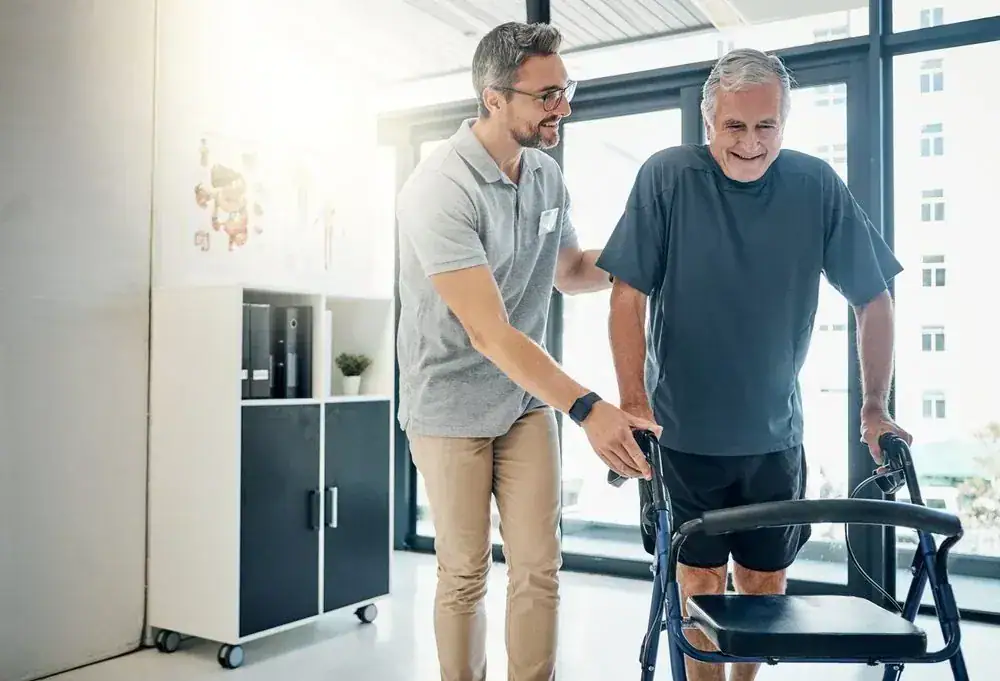
You stop planning your day around what might go wrong. The bathroom at night doesn’t feel like a risk anymore. Getting the mail, reaching for something in the kitchen, standing up from a chair – these stop being calculated decisions.
Most people who start balance exercises for seniors notice steadier movement within four to six weeks. That’s not marketing talk – that’s what happens when you strengthen the right muscles, retrain your coordination, and work with someone who knows how to reduce fall risk in older adults.
Here’s what actually improves: your walking speed picks up, you feel more stable on uneven surfaces, and that constant background fear starts to fade. The goal isn’t just preventing the next fall. It’s getting back to moving through your day without second-guessing every step.
We bring licensed physical and occupational therapists directly to your home in Great Neck Gardens, NY. No waiting rooms, no transportation stress, no trying to get to another appointment when getting around is already the problem.
We’ve worked with hundreds of older adults across Nassau County who were dealing with the same thing you are – whether it’s recovering from a fall, managing Parkinson’s or arthritis, or just noticing balance isn’t what it used to be. Great Neck Gardens has one of Long Island’s largest populations of adults over 65, and many of them face the same fall risks you’re thinking about right now.
We accept Medicare and most commercial insurance. Every therapist on our team is licensed, background-checked, and trained specifically in elderly fall prevention. You’re not getting a generalist – you’re getting someone who understands how aging affects balance and what actually works to improve it.

First, a licensed therapist comes to your home and does a full fall risk assessment. They’re looking at your strength, your balance, how you move through your space, and what’s increasing your risk right now – whether that’s medication side effects, vision issues, or just muscle weakness from avoiding activity.
Then they build a plan based on what you actually need. That might include strength training for your legs and core, balance exercises that retrain your stability, gait training to improve how you walk, or vestibular therapy if dizziness is part of the picture. Everything happens in your home, using your environment, so you’re practicing in the space where you actually live.
You’ll typically have sessions two to three times per week. Most people start seeing improvements around week four – walking feels more controlled, confidence builds, movement gets easier. The full program usually runs eight to twelve weeks, but that depends on where you’re starting and what your goals are.
This isn’t about making you dependent on therapy forever. It’s about giving you the strength, coordination, and confidence to move safely on your own.

Ready to get started?
Every session is built around reducing your specific fall risk. Your therapist will guide you through targeted balance exercises – things like weight shifting, standing on one leg with support, controlled stepping patterns, and movements that challenge your stability in safe, progressive ways. These aren’t random exercises. They’re designed to strengthen the exact systems that prevent falls.
You’ll also work on strength training for your legs, hips, and core. Weak muscles are one of the biggest fall risk factors for older adults, and rebuilding that strength makes a measurable difference. If you’re dealing with dizziness or vertigo, vestibular therapy focuses on retraining your inner ear and visual systems to improve balance.
In Great Neck Gardens, where many homes have stairs, narrow hallways, or older layouts, your therapist will also assess your environment. They’ll identify hazards – loose rugs, poor lighting, clutter – and recommend simple changes that make your home safer. Some sessions include gait training to improve how you walk, especially if you’re compensating for pain or weakness.
One in three adults over 65 falls each year, and Nassau County sees thousands of fall-related ER visits annually. You’re not overreacting by taking this seriously. You’re being smart.

Most people start noticing steadier movement and better confidence within four to six weeks of consistent therapy. That’s the point where your muscles have gotten stronger, your coordination has improved, and your brain has started relearning how to control your balance.
Maximum improvement usually happens around eight to twelve weeks. That doesn’t mean you stop therapy at six weeks – it means that’s when you start feeling the difference in your daily life. You might notice you’re walking faster, you’re not grabbing onto things as much, or you’re less anxious about moving around your home.
The timeline depends on where you’re starting. If you’ve had a recent fall or you’ve been avoiding activity for a while, it might take a bit longer. If you’re catching balance issues early, you might see changes sooner. Consistency matters more than anything – showing up for your sessions and doing the exercises makes the difference.
Yes, Medicare Part B covers home-based physical therapy and occupational therapy when it’s medically necessary. Fall prevention and balance therapy qualify if your doctor orders it and a licensed therapist provides the care.
You’ll need a referral or prescription from your physician, and the therapy has to be part of a treatment plan that shows you need skilled care – meaning a licensed therapist, not just general exercise. We’re Medicare-certified, and we handle the paperwork and billing directly with Medicare.
Most people pay their Part B deductible and then 20% of the Medicare-approved amount. If you have a supplemental plan (Medigap), it often covers that 20%. We also accept most commercial insurance plans. Before we start, we verify your coverage and let you know exactly what your costs will be – no surprises.
It’s not too late. In fact, after a fall is one of the most important times to start therapy. Research shows that physical therapy after a fall can reduce your risk of falling again by up to 37%, and it rebuilds the strength and confidence that often disappear after someone hits the ground.
A lot of people become more fearful and less active after a fall, which actually makes the next fall more likely. Your muscles get weaker, your balance gets worse, and the cycle continues. Therapy breaks that cycle by addressing what caused the fall in the first place – whether it was muscle weakness, poor balance, medication side effects, or environmental hazards.
We start with a full assessment to figure out why you fell and what’s putting you at risk now. Then we build a plan that’s appropriate for where you are today – not where you were before the fall. You’re not starting from scratch. You’re rebuilding with someone who knows how to do it safely.
You can do exercises on your own, but a therapist makes sure you’re doing the right ones, doing them correctly, and progressing safely. A lot of people try balance exercises they find online and either don’t see results or accidentally make things worse by doing movements that aren’t appropriate for their specific issues.
A licensed physical therapist assesses your fall risk factors – strength, coordination, gait, vision, medication effects, home environment – and designs a program based on what you actually need. They watch how you move, correct your form, and adjust the exercises as you improve. That’s not something a video or handout can do.
There’s also the safety factor. Some balance exercises can increase fall risk if you’re not doing them with proper support or progression. A therapist makes sure you’re challenged enough to improve but not so much that you’re at risk. Once you’ve built a solid foundation and you know what to do, you can absolutely continue exercises on your own – but getting it right from the start makes all the difference.
Home therapy eliminates the barriers that keep a lot of older adults from getting care in the first place. You don’t have to arrange transportation, navigate a parking lot, or sit in a waiting room. You’re not exhausted before therapy even starts.
More importantly, you’re working in the environment where you actually live. Your therapist sees the stairs you use, the bathroom layout, the rugs, the lighting – all the things that affect your fall risk every single day. They can assess those hazards and teach you how to move safely in your own space, not in a generic clinic setting.
For people in Great Neck Gardens dealing with mobility limitations, chronic conditions like Parkinson’s or arthritis, or recovery from a fall, getting to a clinic can feel impossible. Home therapy meets you where you are. It’s also more comfortable – you’re in your own space, wearing your own clothes, working with your own furniture. That makes it easier to stay consistent, and consistency is what gets results.
If you’ve fallen in the past year, you’re at higher risk. If you’re afraid of falling or you’ve started avoiding activities because you’re worried about balance, that’s a red flag. Other signs include feeling unsteady when you walk, needing to hold onto furniture or walls to move around, difficulty getting up from a chair, or dizziness when you stand or turn your head.
Medical factors also increase fall risk. Taking four or more medications, having conditions like Parkinson’s, arthritis, osteoporosis, or a history of stroke, and experiencing vision problems or incontinence all make falls more likely. Muscle weakness – especially in your legs and core – is one of the biggest predictors.
Environmental factors matter too. If your home has poor lighting, loose rugs, clutter, or stairs without railings, your risk goes up. In Nassau County, 60% of fall-related hospitalizations happen at home. A therapist can do a formal fall risk assessment that looks at all these factors and gives you a clear picture of where you stand. You don’t have to wait until you fall to take this seriously.
Other Services we provide in Great Neck Gardens