
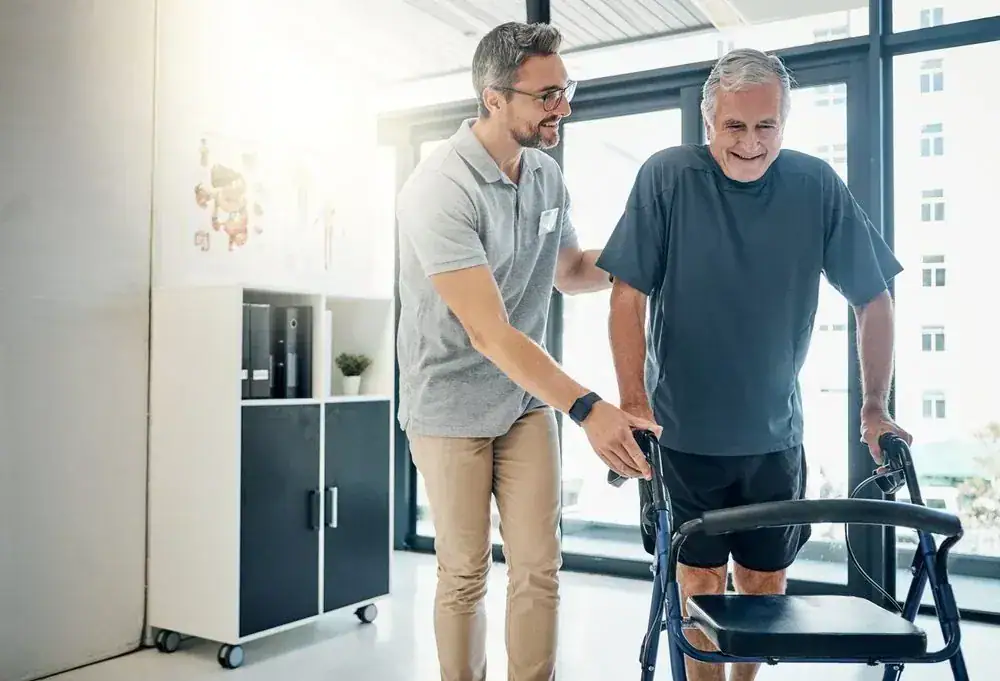
You stop second-guessing every step. You move from room to room without grabbing furniture. You get up from a chair without bracing yourself or worrying about your knees giving out.
That’s what better balance actually looks like. Not just fewer falls—though that matters—but real freedom to do what you need to do without constantly calculating risk.
In Nassau County, 88% of injury hospitalizations for adults over 65 come from falls. That’s not because people aren’t careful. It’s because balance is complicated—your muscles, joints, vision, and inner ear all have to work together, and when one part weakens, the whole system struggles.
Physical therapy for balance addresses all of it. Strength training rebuilds the muscles that keep you upright. Gait training fixes how you walk so you’re not shuffling or favoring one side. Balance exercises retrain your body to catch itself before a stumble turns into a fall. You’re not just being told to “be more careful.” You’re being given the tools to actually be steadier.
We’ve been treating patients across Nassau and Suffolk Counties for over a decade. We specialize in home-based therapy because we know that for many people in Glen Cove—especially those already dealing with mobility challenges—getting to an office is half the problem.
Our therapists are trained in the Otago Exercise Program, a research-backed fall prevention method that’s been shown to reduce falls by up to 35%. We bring that program to your home, where you’re most comfortable and where the work actually matters.
Glen Cove has a higher-than-average senior population—over 20% of residents are 65 or older. We’ve worked with enough people in this community to know what you’re dealing with: stairs without railings, uneven sidewalks, homes that weren’t built with aging in mind. We assess your specific risks and build a plan around your life, not a textbook.

First, we come to your home and do a full fall risk assessment. We look at your medical history, your current strength and balance, how you move through your space, and what’s tripping you up—literally and figuratively.
Then we design a personalized plan. That might include strength exercises to stabilize your legs and core, balance drills to improve your reaction time, and gait training to correct how you walk. If your home has hazards—loose rugs, poor lighting, awkward furniture placement—we’ll point those out too.
You’ll work with a licensed physical therapist who monitors your progress and adjusts your exercises as you improve. Most patients start with two or three sessions per week. Some people see changes in a few weeks. Others take a few months. It depends on where you’re starting and what your goals are.
The program is covered by Medicare and most insurances, so cost usually isn’t a barrier. What matters is that you’re willing to put in the work. This isn’t passive. You’ll be asked to do exercises between sessions. But the payoff—being able to move confidently again—is worth it.

Ready to get started?
You get a customized exercise plan built around your current abilities and your goals. That includes balance exercises for seniors—things like standing on one foot, weight shifts, and controlled movements that retrain your body to stay upright. You also get strength training focused on your legs, hips, and core, because those are the muscle groups that keep you stable.
Gait training is a big part of it too. A lot of falls happen because people develop bad walking habits—shuffling, leaning forward, taking uneven steps. We correct that. You’ll also learn how to get up from a chair safely, how to navigate stairs, and how to recover if you do start to lose your balance.
In Glen Cove, where many homes are older and not designed for aging in place, we also provide education on managing environmental risks. We’ll walk through your home and identify hazards you might not notice—loose carpets, dim hallways, clutter in walkways. Small changes can make a big difference.
Everything happens in your home, on your schedule. You’re not commuting to an office or trying to fit into a group class that doesn’t match your pace. This is one-on-one, personalized care designed to meet you where you are.

Most people notice small changes within the first few weeks—things like feeling steadier when standing up or being able to walk without holding onto walls. Measurable improvements in balance and strength typically show up around the four-to-six-week mark if you’re consistent with your exercises.
That said, everyone’s different. If you’re starting with significant weakness or you’ve had multiple falls, it might take longer. If you’re relatively active but just need some fine-tuning, you might progress faster.
The key is consistency. The exercises work, but only if you do them. Your therapist will adjust the plan as you improve, so you’re always working at the right level—not too easy, not too hard. Studies on the Otago program show that people who stick with it for three to six months see the biggest reduction in fall risk, often around 30% to 35% fewer falls compared to people who don’t do the program.
Yes, Medicare Part B covers physical therapy for fall prevention if it’s deemed medically necessary. That usually means your doctor has identified you as being at risk for falls—whether because of a previous fall, balance issues, muscle weakness, or a condition like arthritis or neuropathy.
You’ll need a referral or prescription from your physician, but once that’s in place, Medicare typically covers the therapy sessions. There may be a copay depending on your plan, but the bulk of the cost is covered.
We also accept most commercial insurances, so if you’re not on Medicare, check with your provider. In most cases, fall prevention therapy is covered because it’s considered a preventive service—and insurers would rather pay for therapy now than pay for a hospital stay after a serious fall. If you’re unsure about your coverage, we can help you verify benefits before we start.
The Otago program is specifically designed for fall prevention in older adults. It’s not general physical therapy—it’s a research-backed protocol that’s been tested in clinical trials and shown to reduce falls by up to 35%.
The program focuses on five key areas: leg strength, balance, walking patterns, home safety, and building the habit of regular exercise. It’s progressive, meaning the exercises get harder as you get stronger, and it’s individualized, so it’s tailored to your specific risks and abilities.
What sets it apart is the structure and the evidence behind it. A lot of general PT programs are helpful, but they’re not always designed with fall prevention as the primary goal. Otago is. Every exercise has a purpose, and the whole program is built around reducing your risk of falling. It’s also designed to be done at home, which makes it more practical for people who have trouble getting to a clinic.
Absolutely. In fact, if you’ve already had a fall, you’re at higher risk for another one, so getting into a fall prevention program is even more important.
After a fall, a lot of people develop what’s called “fear of falling,” which leads them to move less, which leads to more weakness, which increases fall risk. It’s a cycle. Physical therapy breaks that cycle by rebuilding your strength, improving your balance, and giving you the confidence to move again.
We’ll start with an assessment to figure out why you fell in the first place. Was it a balance issue? Muscle weakness? A trip hazard in your home? Once we know the cause, we can address it directly. The exercises are designed to be safe and gradual, so you’re not being pushed beyond what you can handle. The goal is to get you back to feeling steady and secure, not to rush you through a program that doesn’t fit your needs.
Most people do their exercises three to five times a week, depending on what your therapist recommends. Each session usually takes about 30 minutes once you know what you’re doing.
In the beginning, your therapist will be there to guide you and make sure you’re doing the exercises correctly. As you get more comfortable, you’ll do more of the work on your own between therapy visits. That’s actually the point—the goal is to build a routine that you can maintain even after formal therapy ends.
The exercises aren’t complicated. You’re not lifting heavy weights or doing anything that requires special equipment. Most of it is bodyweight movements—standing up from a chair, balancing on one foot, stepping forward and backward. Simple, but effective. The research shows that people who do the exercises regularly see the best results, so consistency matters more than intensity.
Yes. In fact, those are exactly the kinds of conditions that increase fall risk, and physical therapy can help manage them while also improving your balance.
Arthritis makes your joints stiff and painful, which affects how you move. Neuropathy causes numbness or tingling in your feet, which makes it harder to sense where you’re stepping. Both of those things throw off your balance. But targeted exercises can strengthen the muscles around your joints, improve your flexibility, and retrain your body to compensate for sensory loss.
Your therapist will design a plan that works with your limitations, not against them. If certain movements hurt, we’ll modify them. If you have trouble standing for long periods, we’ll build up to it gradually. The goal is to improve your function without making your other conditions worse. And because we’re coming to your home, we can see firsthand what challenges you’re dealing with and adjust the plan accordingly.
Other Services we provide in Glen Cove